As I wander through the digital forests and neon-lit cities of 2026, the lines between developer intent and player imagination continue to blur into a beautiful, haunting tapestry. We all think we know best, don't we? We clutch our controllers, whispering secrets to the screen, convinced we've glimpsed the truth hidden beneath polygons and code. The stories we tell ourselves about these worlds often become more real than the narratives handed to us. They are the ghosts in the machine, the echoes in the save file, the persistent dreams that linger long after the credits roll. Some are flights of fancy, but others... others feel like uncovering a forgotten law of the universe itself. These are the theories that have burrowed deep into my soul, reshaping how I see these worlds I call home.
10. The Dream of a Dying Hero
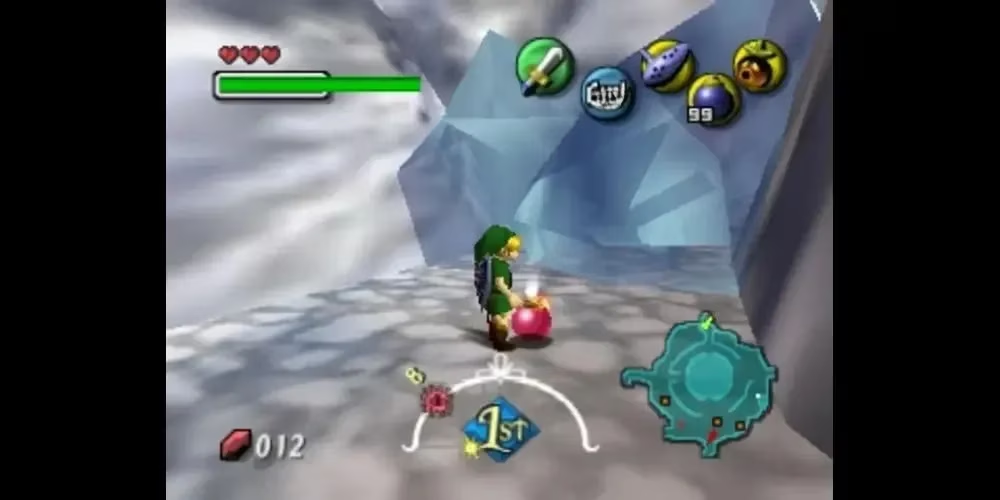
The first chill always comes from Termina. The theory that The Legend of Zelda: Majora's Mask is not an adventure but a hallucination—a final, desperate dream of a hero succumbing to the Lost Woods—has never left me. The evidence is painted in sorrow: the five stages of grief mapped onto the regions, the oppressive, three-day march toward oblivion, and that spectral guide, the Hero's Shade. A left-handed Stalfos, a mirror of a boy lost without his fairy. To play it now is to walk through a eulogy. The carnival music feels like a dirge, the masks like faces of regrets I cannot name. It transforms a quest to save a world into a poignant, personal struggle against the dying of the light.
9. The Truth in the Trunk
Then there is the silence of Silent Hill 2, a quiet so profound it screams. The remake only deepened the fog around James Sunderland. The theory—now widely accepted as the grim truth—that his wife Mary was never missing... she was in the trunk of the car he abandons at the start. This single idea reframes every step, every monster, every whispered plea from Maria. It's not a search; it's a pilgrimage of guilt. The opening scene, once a simple establishing shot, becomes one of the most devastating moments in gaming. He doesn't leave his car to find her. He leaves it to escape what he's already done.
8. A Name Across the Stars
From horror, we leap to the cosmic connections of Final Fantasy. The link between Final Fantasy X-2 and VII is no longer mere speculation—it's woven into the fabric of the series' lore. That young Al Bhed prodigy, Shinra, discussing the energy of the Farplane and journeys to other worlds... he is the seed. The seed that would grow into the monolithic, planet-draining Shinra Electric Power Company. Developer Kazushige Nojima planted this name as a nod, but we, the players, nurtured it into a sprawling family tree. Seeing that founder's portrait in the Remake, the mask a clear callback, feels like witnessing destiny being written in real-time. It's a beautiful reminder that these worlds breathe and grow across centuries, both in-game and in our reality.
7. The Unfinished Ritual
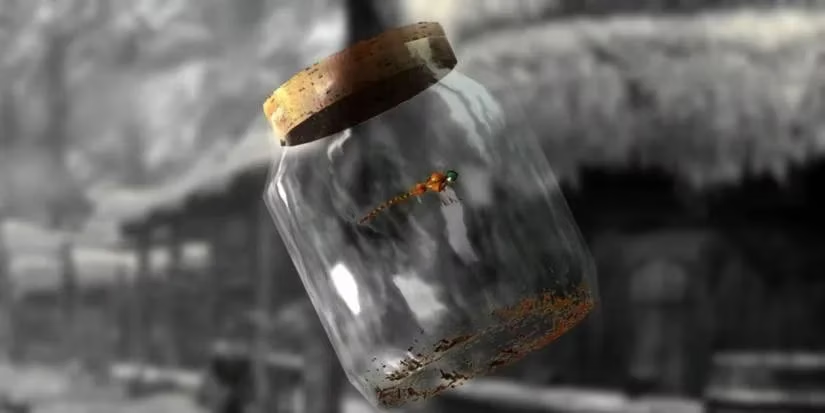
My travels in Skyrim have spanned over fifteen years, yet some corners remain dark. The bug jars. Oh, the bug jars. Scattered like forgotten prayers, each with its enigmatic rune. Plotted on the map, they form a perfect pentagram, and at its heart—the Shrine of Talos. A canceled quest, the developers say. But I don't believe in canceled quests; I believe in ghosts of ideas. This configuration feels like a ritual interrupted, a spell to end the world or summon something unspeakable, frozen in time. It is the ultimate unsolved mystery, a promise in the code that the world is still stranger than we know. As we await the next chapter of Tamriel, I wonder: will this pentagram finally be completed?
6. Worlds Colliding
The idea of a Naughty Dog multiverse is a delightful contagion. That the swashbuckling, globe-trotting world of Uncharted could be the direct precursor to the fungal ruin of The Last of Us... it makes a terrifying kind of sense. The clues are there, laid like breadcrumbs by developers who knew we'd follow: a 2011 newspaper in Uncharted 3 warning of a deadly fungus, the Firefly pendant in Uncharted 4, the recurring Weston's Pharmacy. It suggests a single, fragile timeline where adventure and catastrophe are two sides of the same coin. Could an older Nathan Drake be out there in the overgrown ruins? The theory allows for that hope, a sliver of light in a very dark place.
5. A Final Fantasy, Literally
And then, there is the theory that broke my heart and rebuilt it: Squall is Dead. In Final Fantasy VIII, after Edea's icy assault, the entire back half of the game—the lunatic plot twists, the futuristic Esthar, the journey into space—all of it unfolds in the fading synaptic fire of a dying mind. The evidence is a haunting checklist:
-
The abrupt tonal shift into surrealism.
-
The literal alien abduction.
-
That finale: Squall lost in a limbo of crumbling memories.
-
The chilling, iconic image: his face, dissolving into a void.
It recontextualizes everything. His struggle with connection, his longing for Rinoa, the very title of the game—it all becomes the final, heroic fantasy of a boy making peace with his end. It's not a story about saving the world. It's a story about a boy saving himself, just once, before the lights go out.
4. The Man with Sapphire Eyes
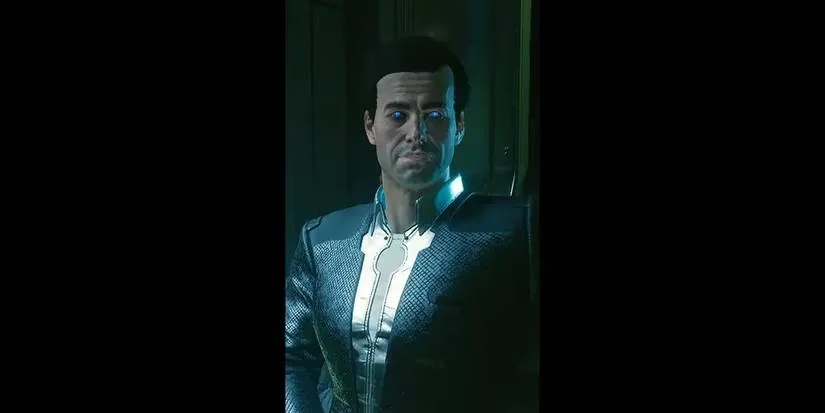
Night City in 2026 is a nest of conspiracies, and at its center sits Mr. Blue Eyes. Who is he? A devil like Gaunter O'Dimm, pulling strings from the shadows? The legendary Morgan Blackhand, watching over Johnny Silverhand's legacy? Or something else entirely—an AI, an alien, a collective consciousness? He appears at the pivotal hinges of fate: watching from a balcony, funding a doomed trip to the moon, offering the ultimate heist. His motives are opaque, transcending mere eddies. He feels like the architect of a game within the game. As we look toward the sequel, his is the face I most anticipate seeing again, a promise that the deepest mysteries of Night City are yet to be plumbed.
3. The Bloodborne Revelation
Bloodborne's most compelling theory is also its most visceral: the entire game is a grotesque allegory for ovulation, menstruation, and conception. Let's trace the bloody trail:
| Clue | Symbolic Meaning |
|---|---|
| Blood administered only by women | The essence of life, gifted by the feminine. |
| Queen Yharnam's bloodied womb | Trauma of birth/loss. |
| Mergo's Wet Nurse | A maddened force of violent extraction. |
| Umbilical Cords | The literal connection to become a Great One. |
| The Nightmare of Mensis | A direct homophone for menses (menstruation). |
We, the Hunters, are the sperm, battling through a womb-like world of Gothic horror, seeking to fuse with the moonlit egg (the Moon Presence) and achieve ascension. It's a breathtaking, audacious reading that FromSoftware's love of arcane symbolism makes utterly plausible. The name of the game was the first clue all along.
2. The Heretics' Truth
In Elden Ring, the friendliest faces may hold the darkest truths. The theory that the wandering Merchants are the true adherents of the Frenzied Flame is, for me, canon. Their story is one of profound tragedy: persecuted, buried alive, their collective anguish summoning the Flame of Frenzy as a last, desperate act of cosmic revolt. Finding their mass grave is a moment of horrific clarity. Their glowing golden eyes aren't a sign of madness, but of a painful, searing enlightenment. This theory turns the game's moral axis on its head. What if the Frenzied Flame—the ending we're warned is a terror—is not destruction, but a violent, necessary mercy? What if the Greater Will is the true villain, and these gentle, wronged merchants saw the only way to burn its golden lies away?
1. The Grand Illusion
The king of all theories remains The Indoctrination Theory for Mass Effect 3. It asserts that Shepard's final confrontation with the Star Child never happens. It's the last, desperate battle inside an indoctrinated mind. The evidence is a symphony of dread:
-
Shepard's worsening, oily-shadow nightmares.
-
The three choices (Synthesis, Control, Destroy) mirroring the fates of Saren and The Illusive Man—the indoctrinated.
-
The red (Destroy) choice causing Harbinger's voice to break through the Star Child's illusion.
-
Shepard's final gasp in the rubble of Earth, having never reached the Citadel.
It transforms a controversial ending into a masterpiece of psychological horror. The Reapers didn't need to crush us with brute force; they needed to break our champion's mind and make him choose genocide, control, or synthesis for them. Choosing Destroy is Shepard shattering the illusion, winning the real war inside his own skull. The developers may deny it, but the pieces fit with an elegance that feels intentional. It is the ultimate player theory: a belief that our hero was stronger, and the truth more complex, than what we were shown.
🌟
These theories are more than just fan speculation. They are the lifeblood of our connection to these worlds. They are the poems we write in the margins of someone else's story, finding new rhythms and hidden rhymes. They prove that a game is never truly finished when the disc stops spinning. It lives on, growing and changing, in the collective dreamscape of its players. We are all part of the canon now, adding verses to an endless song. And in 2026, with new worlds on the horizon, I know the whispers are just beginning.