In the silent, golden light of 2026, the echoes of the Shadow of the Erdtree still resonate deeply within the community. The expansion, a masterstroke of enigmatic storytelling, didn't just add new lands; it cast a profound, unsettling shadow over the very foundations of The Lands Between, stitching questions into the fabric of what players thought they knew. At the heart of this mystery lies a truth whispered in crumbling stone and forgotten pathways: the Land of Shadow was once the pulsing core of this world, a realm now severed, existing as a liminal plane for souls adrift. To think about it is to feel the ghost of a continent, a place that just... up and vanished, leaving only questions in its wake.
The Ghost in the Map: A Cartographic Revelation
The most compelling clue to this ancient sundering isn't found in a grand monologue, but in a simple act of cartographic overlap. Lore seekers, those tireless archaeologists of digital myth, made a stunning discovery. By centering the Suppressing Pillar—that lonely, monumental relic—and laying the map of the Land of Shadow over the familiar contours of The Lands Between, a ghostly alignment emerged. The Shadow's lands fit, almost like a missing puzzle piece, into the empty heart of the base world's map. It's a silent, visual testimony to a cataclysm, a confirmation that what is now a realm of memory was once solid ground. FromSoftware, in its signature style, never says it outright; it simply leaves the maps on the table for us to connect the dots.
The Reign of the Rauh: Stone and Memory
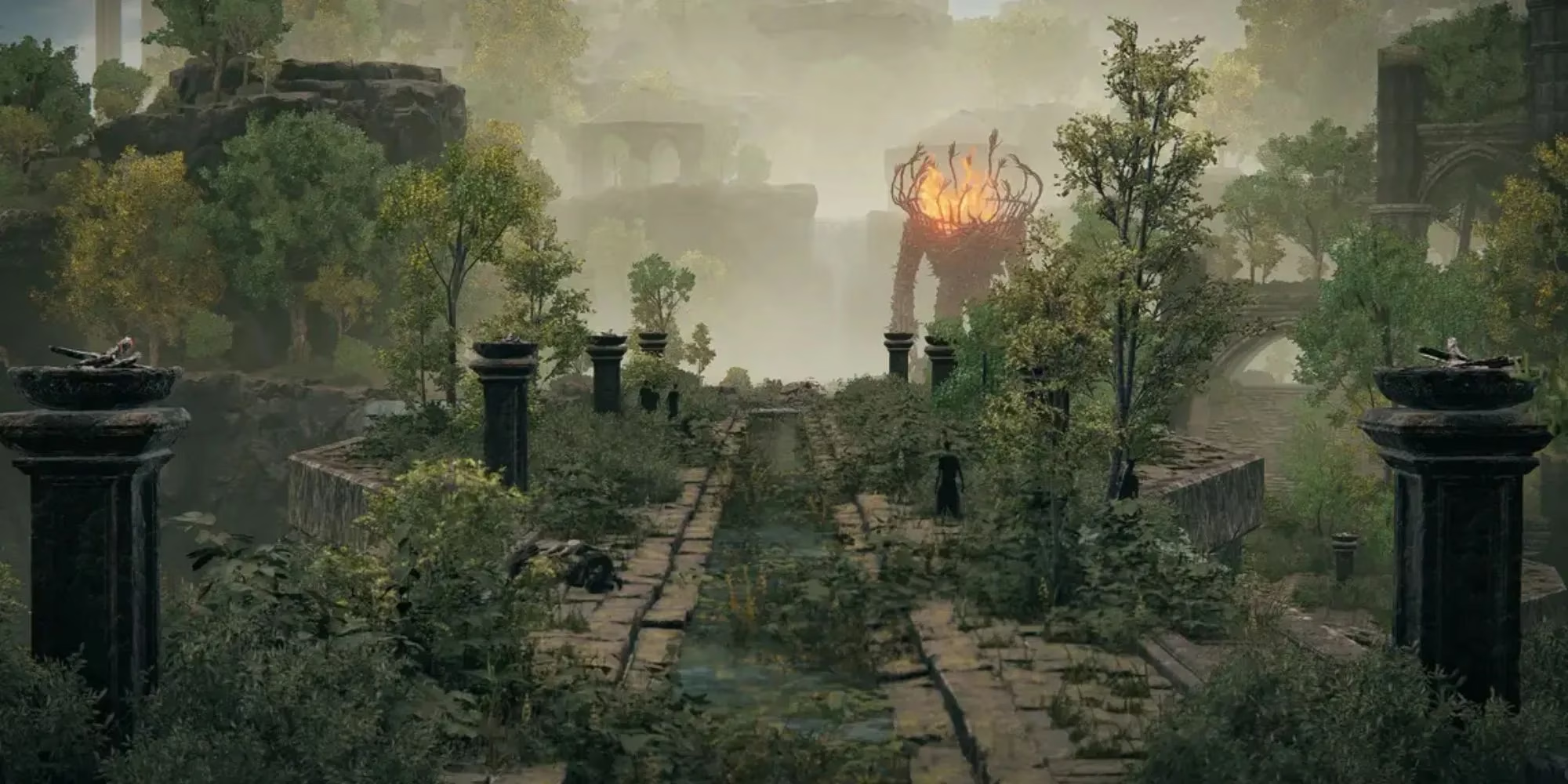
Now, any Tarnished who braved the Shadow will remember the Ancient Ruins of Rauh. This labyrinth of weathered stone, where Messmer's Kindle ignites the path to the celestial Enir-Ilim, feels ancient, heavy with a history that predates the Erdtree itself. With the map's secret in mind, a theory took root, proposed by keen-eyed explorers. These ruins in the Shadow are not unique; they have a twin, a spectral reflection left behind in the waking world.
If you look—really look—the ruins that serpentine their way up to the Altus Plateau in The Lands Between share an uncanny architectural kinship with Rauh. More than just a visual similarity, their positions align perfectly with the theoretical map overlay. The poetry here is breathtaking: those very steps the Tarnished climbs to reach the foot of the golden Erdtree are, in fact, the remnants of a staircase built by a civilization the Erdtree itself ultimately eclipsed. You're literally walking up the bones of the old world to reach the heart of the new. Now that's some worldbuilding, right?
| Location | Realm | Theoretical Connection |
|---|---|---|
| Ancient Ruins of Rauh | Land of Shadow | The original, preserved structure. |
| Altus Plateau Ruins | The Lands Between | The "scar" left behind after the sundering. |
| Forge of the Giants | The Lands Between | A major outpost of Rauh design and industry. |
A Colonization in Stone: The Rauh's Forgotten Footprint
The Altus passageway is just the beginning. The ghost of the Rauh civilization is stamped across The Lands Between, a silent testament to their vast reach. Consider the Forge of the Giants, that colossal, fiery basin. Its stark, geometric, and imposing architecture doesn't match the organic, golden aesthetics of Leyndell; instead, it screams of Rauh design principles—practical, enduring, and massively scaled. Several other scattered ruins share this signature, hinting at a network of outposts, temples, and strongholds. The message is clear: before the Erdtree's grace, before the reign of Marika, the Rauh were here. They colonized, they built, and their legacy was so foundational that even a world-shattering event couldn't erase it completely. Their stones simply remained, waiting for someone to read their story.
-
Architectural Evidence: Recurring motifs of cyclopean stonework, ziggurat-like structures, and a focus on grand, linear ascents.
-
Strategic Placement: Ruins often occupy high ground or spiritually significant locations, suggesting a culture concerned with dominion and perspective.
-
A Contrast in Ideals: The Rauh's enduring stone vs. the Erdtree's living gold represents a fundamental clash of civilizations—one rooted in earthly permanence, the other in divine, cyclical grace.
For those hungry for more—and trust me, the rabbit hole goes deep—the community of lore enthusiasts has woven intricate tapestries of theory around the Rauh, their society, and their fate. The beauty of Elden Ring's world is this layered depth, where every broken wall and silent statue is a page in a history book we're only just learning to read. The ruins of Rauh aren't just a dungeon; they are a memory in stone, a whisper from a time when the world's center was a different kind of holy. And in their quiet, stubborn persistence, they ask the most haunting question of all: what else have we been walking on without ever truly seeing?