Ah, open-world games. Remember when mentioning them would elicit a collective groan? Those days are long gone, thankfully. In the year 2026, developers aren't just making bigger maps; they're crafting living, breathing worlds that demand to be explored. One game, in particular, set the bar so high it's practically in orbit: FromSoftware's Elden Ring. Its sprawling, mysterious Lands Between became the new gold standard. But wait—a challenger approaches from the north, armed with silver swords and a griffin's screech. CD Projekt Red's The Witcher 4 is on the horizon. The question on every gamer's mind in 2026 is a spicy one: can Geralt's successor (or perhaps Ciri's full-fledged adventure) truly rival the masterpiece that is Elden Ring in the open-world department? The potential is there, simmering like a fresh batch of Swallow potion, but it all hinges on CDPR playing its cards with the cunning of a master Gwent player.
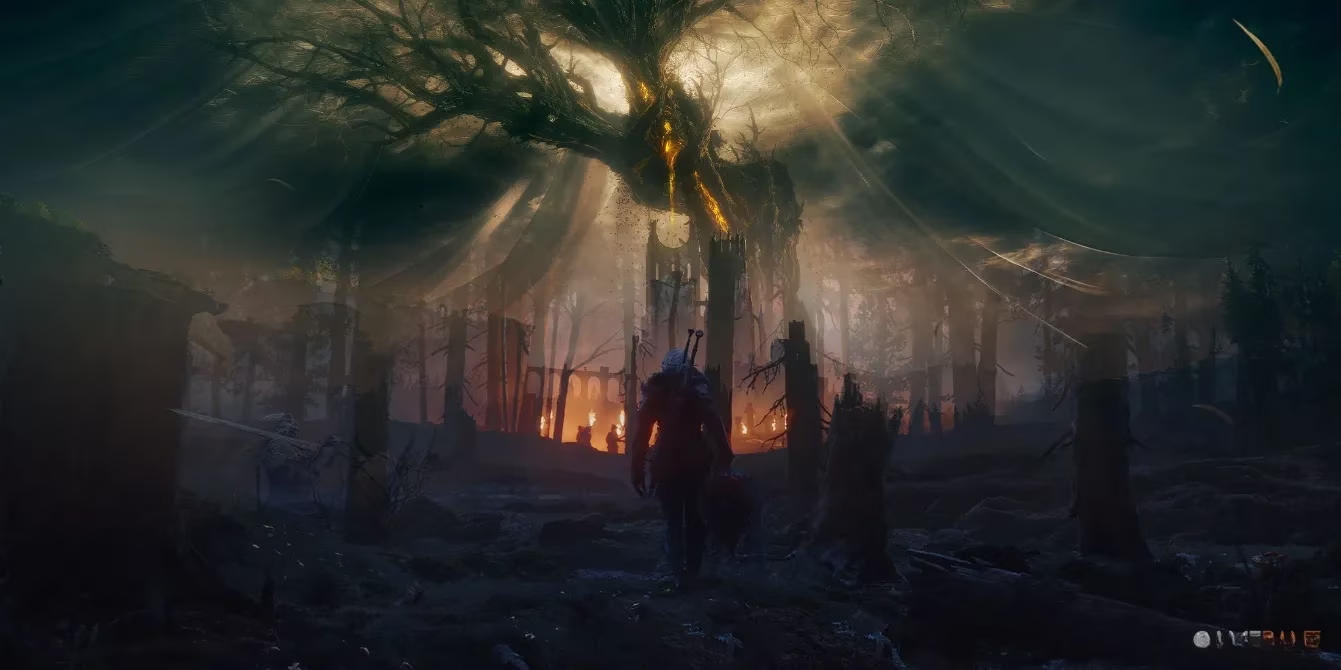
Let's talk about the first and most crucial lesson The Witcher 4 needs to learn from the Tarnished: the art of verticality. Elden Ring didn't just build a world; it stacked it. From the depths of the Siofra River to the peak of the Mountaintops of the Giants, the game is a masterclass in multi-layered exploration. It’s not just about walking from point A to point B. It’s about peering over a cliff, spotting a suspicious cave, and descending into a whole new biome teeming with horrors and treasures. The Shadow of the Erdtree DLC then took this concept and ran with it, creating dizzying, intricate landscapes that felt impossibly deep. Now, The Witcher 3 had its moments—climbing a tower in Novigrad, navigating the rocky coasts of Skellige—but it was largely a ground-level affair. Movement was often restricted to:
-
Scripted ladder climbs 🪜
-
Pre-determined jump points
-
Roach's occasionally erratic gallops 🐎
For The Witcher 4 to compete, it needs to think in three dimensions. Imagine parkouring across the thatched roofs of a bustling new city, chasing a thief through shadowy alleyways and over crumbling walls. Envision delving into vast, multi-leveled necropolises beneath ancient battlefields, where every downward step reveals older, darker secrets. A revamped climbing system, allowing the new Witcher to scale cliff faces or the mossy stones of a forgotten elven tower, would instantly make the world feel exponentially larger and more mysterious. It’s about creating a playground, not just a painting.
The second major pitfall The Witcher 4 must avoid is the dreaded "Ubisoft Tower" syndrome. Let's be honest: while we loved The Witcher 3, its map was sometimes a mess of icons. "Contract: Missing Brother" here, "Bandit Camp" there, a dozen undiscovered Places of Power scattered about. It could start to feel like a monstrous to-do list rather than an organic adventure. Elden Ring, in stark contrast, threw away the checklist. Its magic was in discovery driven purely by player curiosity. You'd see a strange, glowing tree on a distant hill, or a mysterious ruin tucked behind a waterfall, and you'd go investigate—not because a marker told you to, but because you wanted to. The reward was the discovery itself, often leading to a brutal boss fight, a powerful spell, or simply a breathtaking vista.
The Witcher 4 has a golden opportunity to marry its renowned narrative strength with this philosophy. Instead of drowning the player in markers, the world should guide them through:
-
Landmarks: A perpetually smoking mountain peak that hints at a dragon's lair or a volcanic forge.
-
Environmental Storytelling: A trail of broken carts and corpses leading into a dense forest, suggesting a recent monster attack.
-
NPC Dialogue: Rumors heard in a tavern about a "haunted" manor, with only vague directions ("follow the river east until you see the dead willow tree").
This approach would make every contract, every side quest, feel like a personal discovery. Finding a hidden cave wouldn't just be another icon checked off; it would be your secret.
So, what's the verdict as we look ahead in 2026? The ingredients for a world that can stand shoulder-to-shoulder with the Lands Between are all there. CD Projekt Red has already proven it can build worlds that feel lived-in and tell stories that leave emotional scars. The Witcher 4 doesn't need to copy Elden Ring; it needs to absorb its core principles and fuse them with the soul of the Witcher universe.
| Aspect | The Witcher 3's Approach | Elden Ring's Benchmark | The Witcher 4's Potential |
|---|---|---|---|
| World Design | Broad, horizontal, beautiful vistas | Deeply vertical, multi-layered | A fusion: vast landscapes with secret vertical depths 🏔️ |
| Exploration Drive | Quest marker & checklist driven | Curiosity & landmark driven | Narrative-driven curiosity, using witcher senses as a guide 👃 |
| Content Feel | Often like fulfilling tasks | Consistently like genuine discovery | Meaningful discoveries that tie deeply into the lore and world |
In the end, the path is clear. If The Witcher 4 dares to build up and down, not just side to side, and trusts players to find their own way through a world rich with subtle clues and awe-inspiring geography, then yes—it won't just rival Elden Ring. It might just forge a new legend of its own. The open-world throne in 2026 might just have room for two monarchs. Let the duel of the decades begin! ⚔️
As gamers anticipate the next chapter in the Witcher saga, we can only speculate on the innovative twists that developers might incorporate into the gameplay. The anticipation is not just about the narrative or the expansive worlds, but also about the community and resources that support and enhance the gaming experience. For those looking to deepen their engagement, whether through discussions, guides, or finding the best gear and strategies, platforms like Lootbar offer a treasure trove of insights and tools to enrich any gaming journey.
Exploring such resources can be a valuable asset, providing gamers with the opportunity to connect with others who share the same passion and excitement for the Witcher universe and beyond. As players gear up for the adventure that awaits in 2026, having access to a community and resources that enhance the experience can make all the difference. Whether you're seeking to optimize your gameplay or simply want to immerse yourself more deeply in the lore, Lootbar stands ready to guide you through the vast landscapes of fantasy gaming.