In the sprawling, mythic expanse of the Lands Between, a Tarnished's journey is paved with formidable challenges. Among the first and most memorable is the spectral guardian, Margit the Fell Omen, who bars the path to Stormveil Castle with a thunderous staff and a chilling command to abandon ambition. Far later, in the gilded heart of the royal capital, another sovereign menace awaits: Morgott, the Omen King, a ruler cloaked in golden light and righteous fury. To the casual observer, these are two distinct chapters in a saga teeming with demigods and monsters. Yet, a deeper investigation reveals a startling truth—these two pivotal bosses are not merely related; they are one and the same entity, a secret woven into the very fabric of Elden Ring's lore. Their story is a tale of identity, ambition, and a cursed king's desperate defense of an order that has always spurned him.
The Echoes of a Single Voice: Dialogue as the First Clue
The first, haunting hint of their connection lies in their words. When a Tarnished first approaches the gates of Stormveil, a spectral form coalesces, and a voice echoes through the mist: "Foul tarnished, in search of the Elden Ring. Emboldened by the flame of ambition." This proclamation is a gnarled root that extends all the way to the throne room of Leyndell. There, Morgott, the Omen King, rises and delivers a strikingly similar condemnation: "Thy kind are all of a piece. Pillagers. Emboldened by the flame of ambition." The shared rhetoric is no mere coincidence of Omen culture. The definitive proof comes in defeat; should the Tarnished fall to either foe, both utter the same, dismissive epitaph: "Put these foolish ambitions to rest." This verbal fingerprint suggests a singular consciousness behind both forms, like a master playwright using the same poignant line in both the prologue and the final act of a tragedy.
The Unbreakable Chain: Margit's Shackle as Conclusive Proof
While dialogue offers compelling evidence, a single, seemingly mundane item provides irrefutable proof. Early in their journey, a Tarnished can purchase Margit's Shackle from the ever-opportunistic merchant, Patches.

Its item description is a revelation: "Shackles were used to bind the accursed people called the Omen, and these ones were made to keep a particular Omen under strictest confinement." This tool, designed for a specific individual, is useless against other Omen, such as Morgott's own twin brother, Mohg, Lord of Blood. Yet, Margit's Shackle also works to imprison Morgott during his boss fight in Leyndell. This is impossible unless they share the same fundamental essence. The shackle is not a key for a type of lock, but a unique cipher for a single soul. This fact isolates Morgott and Margit as the same being, two masks worn by the cursed son of Queen Marika.
A King's Divided Purpose: Why Morgott Became Margit
Understanding why the Omen King would create the Fell Omen persona requires delving into his tragic history and the state of the Lands Between after the Shattering. Morgott and his twin Mohg were born as Omens, cursed beings shunned and shackled beneath Leyndell in the Subterranean Shunning Grounds—a fate as cruel as being a priceless jewel locked in a rusted strongbox and forgotten. While Mohg embraced his curse and sought power through the outer god known as the Formless Mother, Morgott took the inverse path. He became a fervent, if unlikely, defender of the Golden Order and the Erdtree that had imprisoned him.
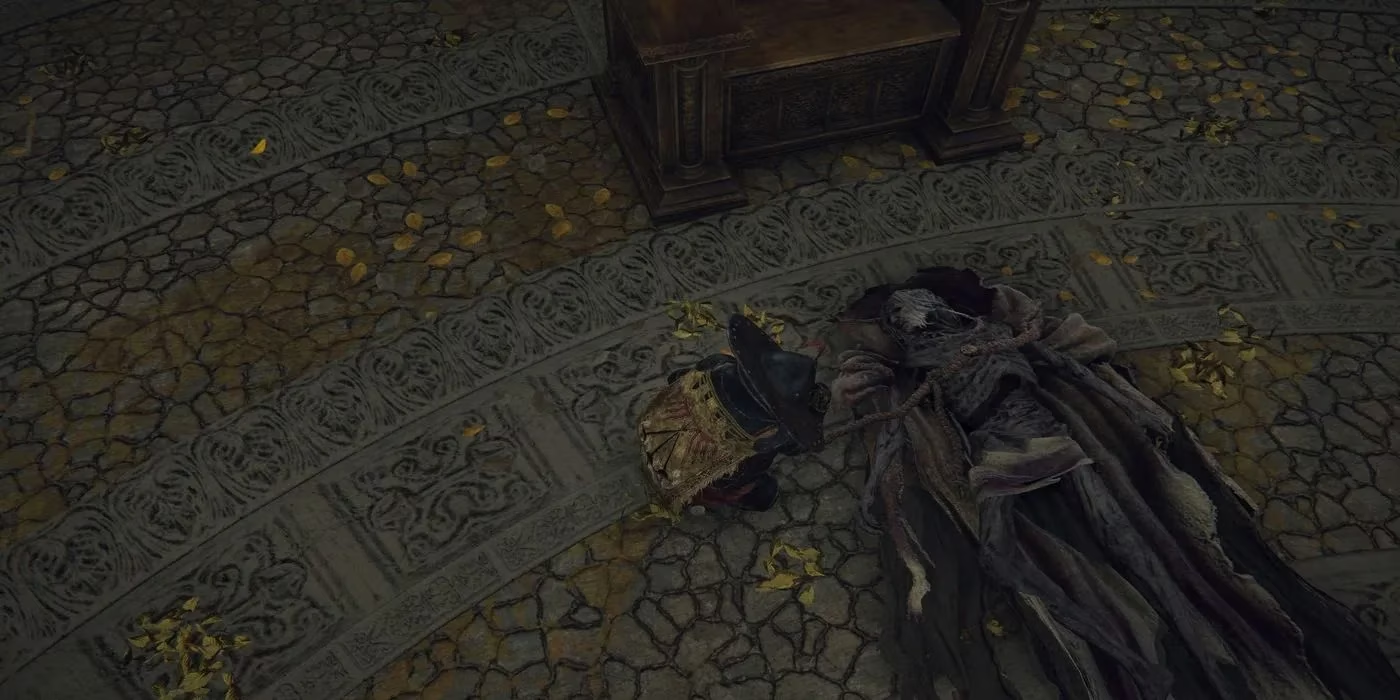
Seizing a Great Rune after the Shattering, Morgott became the de facto ruler of Leyndell, yet he was still denied entry to the Erdtree and an audience with his mother, Marika. This bitter irony—protecting an institution that denies him its ultimate blessing—fueled his contempt for all other aspirants to lordship. From this perspective, the creation of Margit was a brilliant, preemptive stratagem. As described by the Fell Omen Cloak, Margit "slaughtered countless champions during the Shattering" and became "a horror to those who harbor ambitions for the Erdtree."
Godrick the Grafted, the weak and pathetic ruler of Stormveil Castle, was the most obvious first target for any ambitious Tarnished. By projecting a powerful, spectral guardian—Margit—to defend Stormveil's gates, Morgott could eliminate threats far from his seat of power. It was a strategic gambit, like a master chess player sacrificing a potent illusion to protect their king. He aimed to "put these foolish ambitions to rest" before they could ever mature into a challenge worthy of his true, royal self in Leyndell.
Reflections in Combat: Shared Moves and Projected Power
The connection between Margit and Morgott is mirrored perfectly in their combat styles, serving as a martial confirmation of their shared identity. There's an undeniable similarity in how they fight and the nature of their attacks. Both bosses eschew purely physical armaments, instead summoning ethereal weapons of golden, holy light—a manifestation of Morgott's devotion to the Erdtree.
-
Margit conjures a hammer, glowing daggers, and a sweeping sword.
-
Morgott employs a wider, more devastating arsenal, adding spears and the ability to rain down a storm of spiritual blades.
This escalation mirrors their place in the game's progression; Morgott is the fuller, more powerful expression of the same combat philosophy. The parallel extends to Morgott's twin, Mohg, who also has two boss forms (Mohg, the Omen and Mohg, Lord of Blood) with the earlier version using a simpler moveset. This familial pattern cements the idea. Theorists suggest that the "Mohg, the Omen" fought beneath Leyndell is not the true Mohg at all, but another projection created by Morgott to guard dangerous secrets. This supports the notion that Margit is a lesser projection, a sentient shadow sent to Stormveil, which explains his more limited abilities and his body dissipating without a trace, unlike the corporeal corpse Morgott leaves behind.
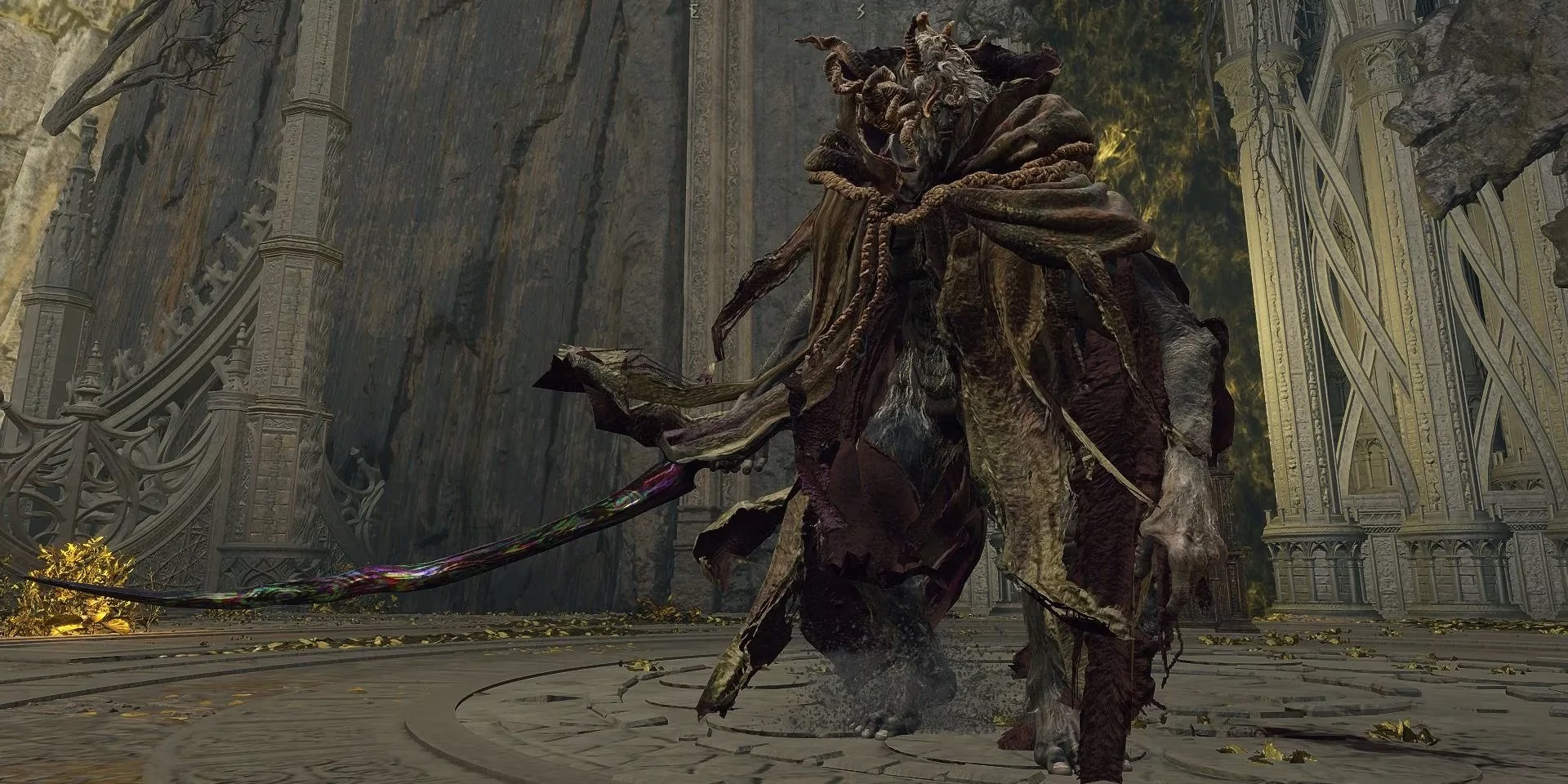
The Legacy of the Veiled King
In the end, the saga of Margit and Morgott is one of Elden Ring's most poignant narratives of identity and defiance. He is a king born into chains, who forged his own crown from the very order that rejected him. His use of the Margit persona was a calculated defense, a way to guard his hard-won station and the Erdtree itself from what he saw as unworthy interlopers. The Tarnished who finally defeats Morgott in Leyndell isn't just overcoming a late-game boss; they are concluding a conflict that began at the very first legacy dungeon, unraveling the final layer of a deception that spanned the entire continent. The Fell Omen and the Omen King stand as two sides of the same cursed coin—one the sharp, forbidding edge meant to deter, the other the intricate, burdened face of a monarch protecting a throne he can never truly occupy. Their unified story is a testament to the deep, interconnected lore that makes the world of the Lands Between feel endlessly alive and shrouded in mystery.