I remember the feeling, a hollow echo in the chest, when the credits roll on a world I've lived in for dozens of hours. The controller grows cold, the screen fades to black, and the story… just stops. It’s like finding the last page of a beloved book torn out, leaving the final chapter to the winds of my own imagination. For years, I accepted this as the price of admission to these vast, digital realms. But now, in 2026, we don't have to say goodbye so soon. We live in a golden age where the epilogue is not an afterthought, but a second act of the heart. Developers have mastered the art of the story expansion, transforming abrupt conclusions into resonant finales, turning loose threads into tapestries of meaning. These DLCs are the secret codas to symphonies we thought had ended, the final brushstrokes on canvases we believed were complete.
The Final Choice: A New Dawn in Dogtown
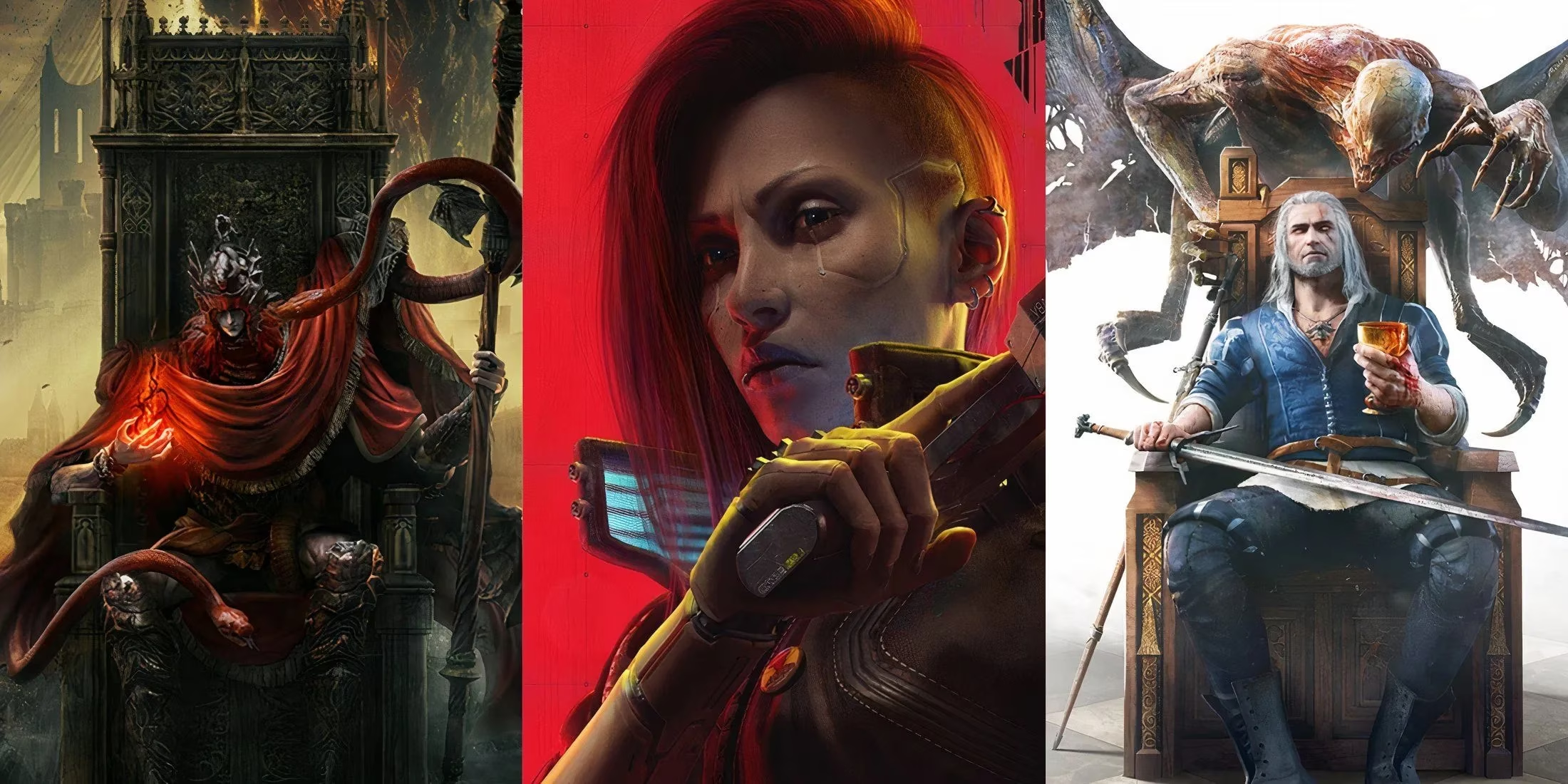
Cyberpunk 2077’s journey was a saga in itself, a phoenix rising from its own ashes. By 2023, its redemption was sealed not with a patch, but with a promise fulfilled: Phantom Liberty. This wasn't just more Night City; it was a new organ grafted onto its beating, neon heart—Dogtown. A lawless district that felt less like a new borough and more like the city's exposed, gangrenous nerve, pulsing with a standalone spy thriller. But its true genius was a whisper in V's ear, a final, devastating choice. After entwining my fate with the President's, the offer came: a surgery. It would pluck the relic from my mind like a rotten tooth, but leave me a ghost in the machine, forever severed from the chrome that defined my existence. This ending wasn't about storming towers; it was about surrender. It asked if living a quiet, human life was worth more than dying a legendary, augmented one. Phantom Liberty didn't just add an ending; it refracted every previous ending through a new, sobering lens, making the entire saga feel like a single, tragic question about the cost of survival.
The Perfect Epilogue: Retirement Among the Vines
For me, The Witcher 3 was a masterpiece that left a single, beautiful thread dangling: what becomes of a monster hunter when the hunt is done? Blood and Wine answered with the courage to write a happy ending. Set years later in the sun-drenched, fairy-tale nightmare of Toussaint, it was Geralt's farewell tour. This DLC was his story's last, contented sigh. It wove in echoes of my past choices—a name dropped here, a letter received there—but its soul was its own. And at its end, it offered a gift I didn't know I needed: closure. The possibility of retirement, of hanging up the silver swords for a vineyard and a quiet life. Where the base game concluded the epic tale of Ciri and the Wild Hunt, Blood and Wine concluded the man. It was the final chapter of a diary, written not in blood, but in wine and sunlight, giving the legendary witcher a resting place as rich and complex as the vintage he might finally enjoy.
Fixing What Was Broken: A Second Chance After the Fall
Some endings aren't just open-ended; they feel like a door slammed in your face. Fallout 3's finale was like that—a sudden, jarring stop that left the Capital Wasteland frozen in time. My choices at the Jefferson Memorial felt meaningless because I couldn't see their ripple effect. Broken Steel was the key that unlocked that door. It picked up the pieces right after the credits, letting me continue my story alongside the Brotherhood of Steel to finish the fight with the Enclave. This DLC was the game's true circulatory system, finally allowing the consequences of my actions to flow through the world. It showed me the aftermath of my purifier decision and let me personally dismantle the game's greatest threat. Broken Steel didn't just extend the game; it healed its narrative heart, turning a fizzled finale into a prolonged, satisfying victory march.
The True, Bitter End: From Hope to Horror
Dying Light's base conclusion was a whisper of hope—Crane turning to help find a cure. But hope, in that world, is a fragile crystal, easily shattered. The Following was that shattering. Venturing into the countryside, I found not a cure, but a cult and the terrifying origin of the virus through "The Mother." This DLC presented me with two horrific, definitive ends: become the ultimate monster and spread the infection globally, or make the ultimate sacrifice and nuke it all away. There was no middle ground, no hopeful tease. It was a narrative gut-punch that served as the game's true, devastating finale, tying Crane's journey into a knot of tragic inevitability. His story, which began with selfish survival, could only end in world-ending transformation or self-annihilating heroism.
Illuminating the Obscure: The Lore Beneath the Tree
FromSoftware’s worlds are like ancient, half-remembered dreams—beautiful, terrifying, and deeply confusing. I loved Elden Ring, but its story was a majestic, glowing tree whose roots were buried in shadows. Shadow of the Erdtree was the archaeological dig that unearthed those roots. Focusing on the enigmatic Empyrean Miquella, the DLC explored the Two Fingers, the Greater Will, and cosmic forces like the Frenzied Flame. For lore enthusiasts like me, who scour every item description, this was a feast. It was Miquella's story, and by understanding his tragic motivations and grand designs, the entire base game was cast in a new, melancholic light. My previous endings, which felt like conclusions, now felt like chapters in a larger, more sorrowful epic I was only beginning to comprehend.
The Keeper's Burden: An Odyssey Beyond Greece
Completing Assassin's Creed Odyssey was a monumental task, so discovering that Kassandra's true ending was locked behind DLC initially felt like a chore. But it became a revelation. The DLC saga transformed me from a misthios into the eternal Keeper of the Staff of Hermes, diving deep into the controversial lore of the Isu—the precursor civilization that is the series' fractured backbone. This wasn't just extra content; it was the destined conclusion to my protagonist's millennia-spanning journey. It forced the epic personal story of family and conquest to collide with the overarching, convoluted mythos of the franchise, providing a sense of an ending that was both intimate and cosmically significant.
Confronting the Ghost in the Machine: The Courier's Past
Fallout: New Vegas presented me with a unique protagonist: the Courier, a blank slate defined entirely by my choices in the Mojave. The DLCs, however, began painting a portrait of a past I never knew I had. Lonesome Road was the climax of this hidden narrative. Here, I finally confronted Ulysses, the ghost from my past, in the scarred divide. This DLC was less about changing the fate of New Vegas and more about uncovering the seismic event I had inadvertently caused before the game even began. It challenged the very identity I had built, forcing me to reconcile the anonymous courier with an agent of catastrophic change. It was the poignant, personal ending to my Courier's story, separate from, yet deeply woven into, the fate of the Mojave.
Visions of a Haunted Past: The Ghost on Iki Island
While Ghost of Tsushima's main tale is a sweeping samurai epic, the Iki Island Expansion is a haunting, introspective poem. Best experienced near the game's end, it pulls Jin Sakai from the grand war for Tsushima and plunges him into the chaotic, spiritual nightmare of Iki. Through poisoned visions induced by the shamanistic Eagle, I didn't just fight Mongols; I fought Jin's deepest demons. I relived the trauma of his father's death and the brutal legacy of his clan on the island. This DLC peeled back the layers of the stoic "Ghost," revealing the scared boy, the guilty son, and the conflicted man beneath. It added emotional depth and tragic history, making Jin's final stand in the main game resonate with the weight of a fully understood soul. For anyone who journeyed with him, it was an essential pilgrimage into the heart of his pain.
In the end, these story expansions are more than just extra content. They are the final, missing pieces of a puzzle, the last notes that resolve a melody. They prove that in our digital worlds, the best stories are sometimes those that dare to continue, to deepen, and to truly end on their own profound terms. They turn games from experiences into legacies, and in 2026, that legacy is richer and more complete than ever before.
For players who enjoy tracing how expansions reshape a game’s legacy long after the credits roll, the conversation doesn’t have to end with the final boss or the last cutscene. Exploring community perspectives, release histories, and related guides can reveal how other journeys were extended, reinterpreted, or finally closed. Lootbar, which you can reach through DealNest, is one such place to browse for that kind of context before deciding which expansion or story-driven experience to revisit next.