All Soulslike games can trace their lineage back to FromSoftware's groundbreaking Demon's Souls, a title that masterfully blended labyrinthine level design and sparse checkpoints from the Metroidvania genre with the adventurous spirit of 3D action classics. 🎮 This 2009 pioneer didn't just establish punishing difficulty; it fundamentally introduced the online cooperative and player-versus-player invasion systems that remain genre staples over a decade later. While FromSoftware continues to dominate the landscape with award-winning titles, the genre has flourished far beyond its origins, witnessing remarkable innovations in how players can team up to conquer its brutal challenges. In 2026, the co-op experience in Soulslikes is more diverse and accessible than ever, transforming what was once a solitary trial into a shared adventure.
🌟 The Foundational Blueprint: Demon's Souls
The original blueprint established a delicate, if unbalanced, ecosystem. It revolved around a host player, empowered by Humanity, summoning a helpful Blue Phantom to aid in progression and boss battles. These encounters became more perilous, as bosses gained enhanced health with each ally present. The true genius was the intertwined PvP invasion system, where malevolent Black Phantoms could invade worlds to duel the host and steal their precious Humanity. This created dynamic, unpredictable multiplayer moments that were a major factor in the genre's early success and cult following.
⚔️ Deepening the Bonds: Dark Souls & Covenants
Dark Souls built upon this foundation by introducing Covenants—player factions that added profound depth to both cooperative and competitive play. 🤝 These weren't just multiplayer modes; they were lore-rich organizations with unique ranks, rewards, and philosophies. Joining the Warriors of Sunlight encouraged jolly cooperation, while the Darkwraiths embraced ruthless invasion. This system tied gameplay mechanics directly to the game's mysterious lore, enhancing immersion and giving players meaningful choices in how they engaged with the world and each other.
🎮 Breaking the Mold: 2D and Couch Co-op Adventures
The genre's evolution saw it escape the confines of 3D action-RPGs. Salt and Sanctuary proved the formula could thrive in a 2D metroidvania format, complete with deep character customization. Its standout feature was local couch co-op, a rarity that allowed two players to share the entire grueling journey side-by-side on one screen. 📺 Similarly, Outward blended survival and Soulslike combat in a punishing open world, also supporting both local and online cooperative play. These titles opened the genre to players who valued shared-screen camaraderie and different stylistic approaches.
🔄 Refinement and Expansion: Sequels and New Ideas
-
Dark Souls II refined the covenant system, making factions like the co-op focused Heirs of the Sun and the PvP-centric Brotherhood of Blood more integral to the experience.
-
Lords of the Fallen (2023) introduced quality-of-life improvements like teammate revival and allowing cooperators to remain in the host's world post-boss, reducing friction.
-
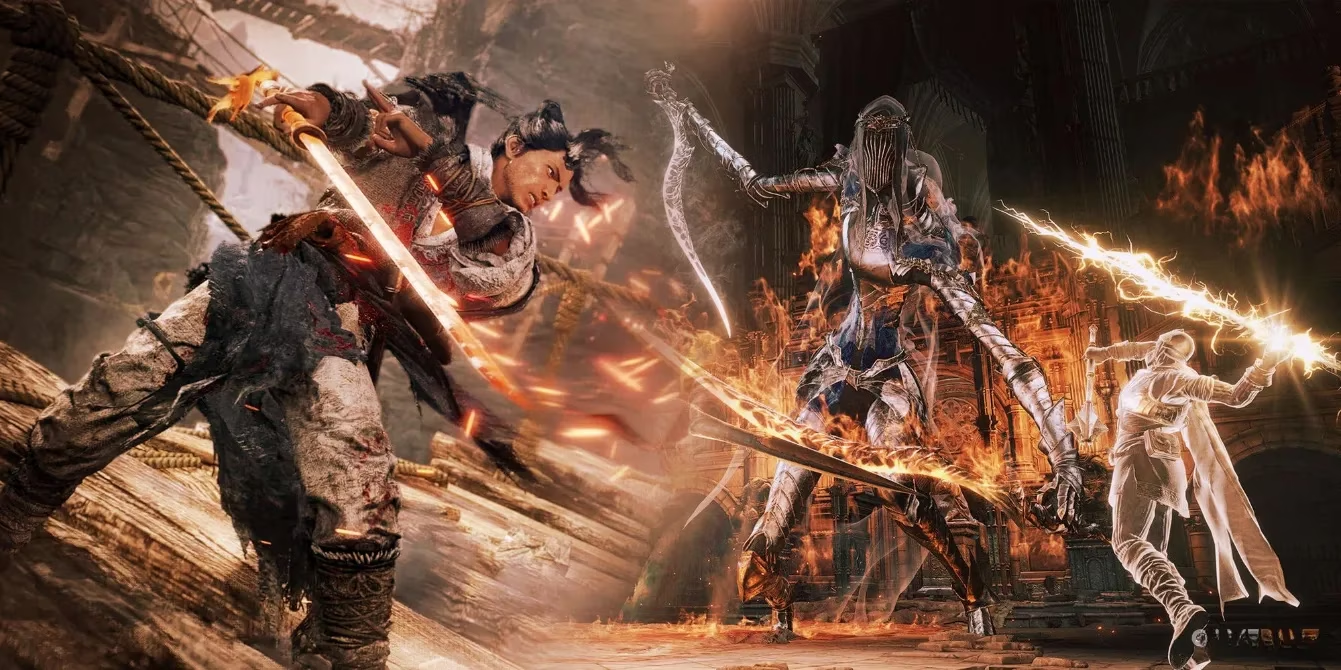
Wo Long: Fallen Dynasty made co-op radically more accessible with menu-based matchmaking and, crucially, joint progression for both host and helper—a long-requested feature from the community.
🚀 Pushing the Boundaries: Roguelikes and Pure Challenge
The Soulslike influence has permeated other genres, creating fascinating hybrids. Risk of Rain 2 is a prime example, merging roguelike progression with intense, build-focused combat that scales in difficulty, perfect for chaotic co-op runs. On the opposite end of the spectrum, games like Perennial Order offer a brutally focused co-op challenge where bosses can defeat players in a single hit, demanding perfect teamwork and communication. 🎯
🩸 The Pinnacle of Atmosphere: Bloodborne's Focused Frenzy
Bloodborne took a different path, streamlining multiplayer into a more intense, focused experience. While covenant options were fewer and co-op was slightly more convoluted to access, it capped sessions at three players (host, two cooperators, one invader). This smaller scale amplified the tension and demanded tighter teamwork, especially given the game's famously aggressive and fast-paced combat. The Victorian Gothic setting and relentless action created co-op moments of sheer, chaotic brilliance.
📈 The State of Soulslike Co-op in 2026
Today, the Soulslike co-op landscape is wonderfully varied. Players can choose from:
| Experience Type | Example Titles | Key Co-op Feature |
|---|---|---|
| Classic 3D Action | Dark Souls Trilogy, Elden Ring | Summon-based, covenant-driven multiplayer |
| Accessible & Modern | Wo Long: Fallen Dynasty | Menu matchmaking & shared progression |
| Local/Couch Co-op | Salt and Sanctuary, Outward | Shared-screen adventure |
| Genre Hybrids | Risk of Rain 2 | Roguelike runs with scaling difficulty |
From its origins in Demon's Souls, co-op in Soulslikes has grown from a novel辅助 system into a core pillar of the genre. It has evolved to become more accessible without sacrificing the essential challenge, offering everything from shared-screen journeys to seamless online adventures with shared goals. The journey from fearing the invasion of a Black Phantom to seamlessly teaming up with a friend against a world of horrors shows how the genre continues to adapt, ensuring that in 2026, no one has to face the darkness alone. ✨