In the ever-evolving landscape of video games, the Soulslike genre remains a titan of challenge and reward, captivating players with its demanding combat, intricate worlds, and deep customization. By 2026, the genre has matured far beyond its foundational pillars of punishing difficulty and dark fantasy. A core element that continues to define and differentiate these experiences is the class or build system, which acts as the architectural blueprint for a player's journey. Rather than rigid templates, modern Soulslikes offer fluid frameworks—like a blacksmith's forge where players can temper raw attributes into a personalized weapon of war—allowing for unprecedented freedom in defining one's playstyle. From blood-infused codes to collected shells, developers have continuously reimagined how players engage with their character's growth, ensuring that the path to conquering daunting bosses is as unique as the player wielding the controller.
Code Vein: The Blood Code Tapestry
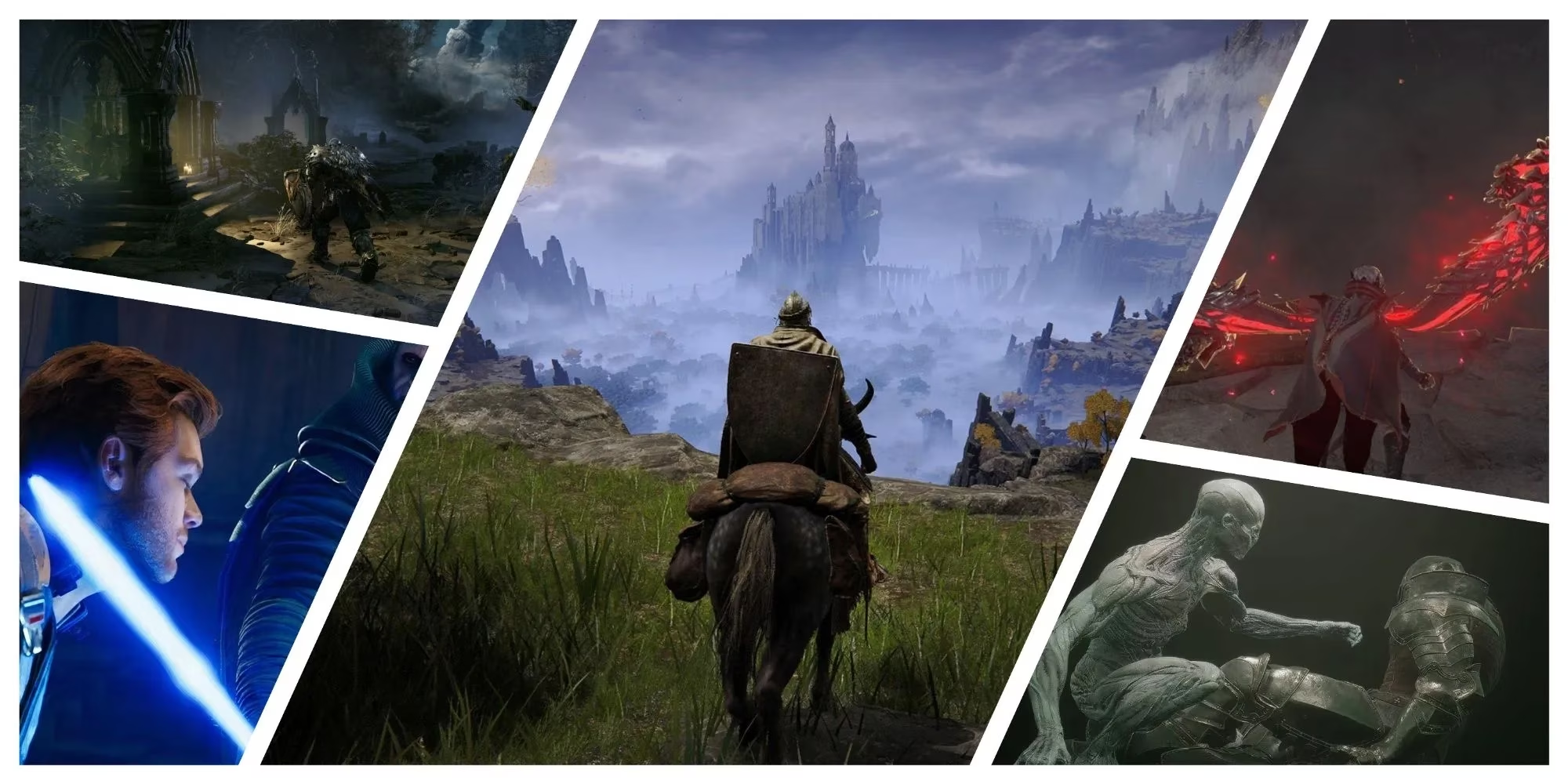
Set in a haunting, post-apocalyptic future overrun by vampiric entities known as the Lost, Code Vein presents a class system as intricate as a genetic lattice. Eschewing traditional archetypes, the game employs "Blood Codes," which are essentially inherited memories and abilities from powerful Revenants. Players don't just pick a class; they weave together a tapestry of skills from codes like the agile Ranger, the brute-force Berserker, or the elemental Caster. The system's genius lies in its modularity; you can swap Blood Codes almost on the fly, mixing and matching abilities from different codes to create hybrid builds that would make a mad alchemist proud. This allows for dynamic adaptation to different challenges, making the high-stakes narrative feel intensely personal. The freedom to customize is so vast that crafting an overpowered build feels less like following a recipe and more like conducting a symphony of devastation.
Lords of the Fallen: A Grim Palette of Thirteen
Lords of the Fallen carves its identity within a universe as cold and unforgiving as a glacier's heart. While its aesthetic homage to Dark Souls is unmistakable, its class system offers a robust and traditional counterpoint. With a roster of 13 distinct classes, the game provides a comprehensive palette for players to paint their journey. Whether one chooses the holy path of a Cleric, the shadowy steps of a Rogue, or the balanced approach of a Warrior, each selection fundamentally shapes the early and mid-game experience. This variety ensures that tackling the game's formidable enemies and challenging bosses never feels monotonous across playthroughs. Choosing the right class is not merely a starting preference but a strategic commitment, akin to selecting the proper key for a complex and deadly lock.
Mortal Shell: The Hollows' Inheritance
Mortal Shell takes a radically different approach, forgoing a class selection screen entirely for a system of discovery and possession. In the decaying world of Fallgrim, power is not chosen but claimed from the fallen. Players discover Shells—the petrified remains of mighty warriors—each acting as a distinct "class vessel." Donning a Shell is like stepping into a frozen echo of another's life, granting unique stat distributions, abilities, and even a special hardening skill. With only four Shells to find—such as the durable Harros or the nimble Tiel—the variety is more curated than expansive. However, this limitation fosters deep mastery. Each Shell fundamentally alters the rhythm of combat, transforming the player's approach from a clumsy wanderer into a specialized phantom of war. The system is a poignant metaphor for the game's world: identity is fragile, borrowed, and essential for survival.
Lies of P: A Puppet's Three Paths
In the belle époque-inspired city of Krat, Lies of P tasks players with guiding a mechanized puppet named P. Its class system is elegantly simple yet effective, offering three core starting paths: Strength, Dexterity, and Advance (which focuses on elemental weapons and status effects). This tripartite foundation is deceptively deep. While the initial choices are fewer, the progression system, centered on a unique P-Organ upgrade tree, allows for significant specialization within each path. The chosen path dictates not only your starting weapon but also the early-game strategy against the game's hostile puppets and terrifying bosses. It’s a system that proves restraint can breed depth, offering a focused experience where every stat point feels like a deliberate turn of a clockwork gear, moving you closer to becoming a real boy—or a perfect fighting machine.
Salt and Sanctuary: The 2D Hybrid Apex
Salt and Sanctuary masterfully fuses the punishing mechanics of a Soulslike with the sprawling, interconnected world of a Metroidvania, and its class system is a microcosm of this brilliant hybrid design. It offers a solid selection of eight starting classes, from the straightforward Knight to the unconventional support-focused Chef. However, the true brilliance lies in its enormous, sprawling skill tree. This skill tree functions less like a rigid class system and more like a flexible canvas for player imagination. Here, players can combine elements from different classes to create powerful builds. This freedom to customize your character is a hallmark of the genre, and the ability to craft a build is a testament to the developer's ingenuity. Starting with a simple class like a mage, you can quickly become a formidable force on the battlefield. The skill tree is a complex and rewarding system, allowing for deep specialization or eclectic hybridization.
Star Wars Jedi: Survivor: The Stance Dance
Star Wars Jedi: Survivor continues Cal Kestis's story with refined lightsaber combat that substitutes a formal class system for a dynamic "Stance" mechanic. Cal can unlock and switch between several fighting stances, such as the balanced Single Blade, the aggressive dual-wielding Double-Bladed, or the heavy-hitting Crossguard. Each stance is a self-contained combat philosophy, altering speed, range, damage, and special moves. This system allows players to adapt their strategy on the fly, dancing between styles like a composer shifting between musical movements to suit the rhythm of the battle. It emphasizes fluid mastery over static archetypes, making the player feel like a true Jedi adapting to any threat.
Elden Ring: The Golden Standard
Few titles have reshaped the genre's landscape like Elden Ring. Its class system is the culmination of From Software的阴影,下面是一个阴影阴影阴影阴影阴影阴影阴影阴影阴影阴影阴影阴影阴影阴影阴影阴影阴影阴影阴影阴影阴影阴影阴影阴影阴影阴影阴影阴影阴影阴影阴影阴影阴影阴影阴影阴影阴影阴影阴影阴影阴影阴影阴影阴影阴影阴影阴影阴影阴影阴影阴影阴影阴影阴影阴影阴影阴影阴影阴影阴影
?
?
?
?
?
?
?
?
?
?
?
?
?
?
?
?
?
?
?
?
?
?
?
?
?
?
?
?
?
?
?
?
?
?
?
?
?
?
?
?
?
?
?
?
?
?
?
?
?
?
?
?
?
?
?
?
?
?
?
?
?
?
?
?
?
?
?
?
?
?
?
?
?
?
?
?
?
?
?
?
?
?
?
?
?
?
?
?
?
?
?
?
?
?
?
?
?
?
?
?
?
?
?
?
?
?
?
?
?
?
?
?
?
?
?
?
?
?
?
?
?
?
?
?
?
?
?
?
?
?
?
?
?
?
?
?
?
?
?
?
?
?
?
?
?
?
?
?
?
?
?
?
?
?
?
?
?
?
?
?
?
?
?
?
?
?
?
?
?
?
?
?
?
?
?
?
?
?
?
?
?
?
?
?
?
?
?
?
?
?
?
?
?
?
?
?
?
?
?
?
?
?
?
?
?
?
?
?
?
?
?
?
?
?
?
?
?
?
?
?
?
?
?
?
?
?
?
?
?
?
?
?
?
?
?
?
?
?
?
?
?
?
?
?
?
?
?
?
?
?
?
?
?
?
?
?
?
?
?
?
?
?
?
?
?
?
?
?
?
?
?
?
?
?
?
?
?
?
?
?
?
?
?
?
?
?
?
?
?
?
?
?
?
?
?
?
?
?
?
?
?
?
?
?
?
?
?
?
?
?
?
?
?
?
?
?
?
?
?
?
?
?
?
?
?
?
?
?
?
?
?
?
?
?
?
?
?
?
?
?
?
?
?
?
?
?
?
?
?
?
?
?
?
?
?
?
?
?
?
?
?
?
?
?
?
?
?
?
?
?
?
?
?
?
?
?
?
?
?
?
?
?
?
?
?
?
?
?
?
?
?
?
?
?
?
?
?
?
?
?
?
?
?
?
?
?
?
?
?
?
?
?
?
?
?
?
?
?
?
?
?
?
?
?
?
?
?
?
?
?
?
?
?
?
?
?
?
?
?
?
?
?
?
?
?
?
?
?
?
?
?
?
?
?
?
?
?
?
?
?
?
?
?
?
?
?
?
?
?
?
?
?
?
?
?
?
?
?
?
?
?
?
?
?
?
?
?
?
?
?
?
?
?
?
?
?
?
?
?
?
?
?
?
?
?
?
?
?
?
?
?
?
?
?
?
?
?
?
?
?
?
?
?
?
?
?
?
?
?
?
?
?
?
?
?
?
?
?
?
?
?
?
?
?
?
?
?
?
?
?
?
?
?
?
?
?
?
?
?
?
?
?
?
?
?
?
?
?
?
?
?
?
?
?
?
?
?
?
?
?
?
?
?
?
?
?
?
?
?
?
?
?
?
?
?
?
?
?
?
?
?
?
?
?
?
?
?
?
?
?
?
?
?
?
?
?
?
?
?
?
?
?
?
?
?
?
?
?
?
?
?
?
?
?
?
?
?
?
?
?
?
?
?
?
?
?
?
?
?
?
?
?
?
?
?
?
?
?
?
?
?
?
?
?
?
?
?
?
?
?
?
?
?
?
?
?
?
?
?
?
?
?
?
?
?
?
?
?
?
?
?
?
?
?
?
?
?
?
?
?
?
?
?
?
?
?
?
?
?
?
?
?
?
?
?
?
?
?
?
?
?
?
?
?
?
?
?
?
?
?
?
?
?
?
?
?
?
?
?
?
?
?
?
?
?
?
?
?
?
?
?
?
?
?
?
?
?
?
?
?
?
?
?
?
?
?
?
?
?
?
?
?
?
?
?
?
?
?
?
?
?
?
?
?
?
?
?
?
?
?
?
?
?
?
?
?
?
?
?
?
?
?
?
?
?
?
?
?
?
?
?
?
?
?
?
?
?
?
?
?
?
?
?
?
?
?
?
?
?
?
?
?
?
?
?
?
?
?
?
?
?
?
?
?
?
?
?
?
?
?
?
?
?
?
?
?
?
?
?
?
?
?
?
?
?
?
?
?
?
?
?
?
?
?
?
?
?
?
?
?
?
?
?
?
?
?
?
?
?
?
?
?
?
?
?
?
?
?
?
?
?
?
?
?
?
?
?
?
?
?
?
?
?
?
?
?
?
?
?
?
?
?
?
?
?
?
?
?
?
?
?
?
?
?
?
?
?
?
?
?
?
?
?
?
?
?
?
?
?
?
?
?
?
?
?
?
?
?
?
?
?
?
?
?
?
?
?
?
?
?
?
?
?
?
?
?
?
?
?
?
?
?
?
?
?
?
?
?
?
?
?
?
?
?
?
?
?
?
?
?
?
?
?
?
?
?
?
?
?
?
?
?
?
?
?
?
?
?
?
?
?
?
?
?
?
?
?
?
?
?
?
?
?
?
?
?
?
?
?
?
?
?
?
?
?
?
?
?
?
?
?
?
?
?
?
?
?
?
?
?
?
?
?
?
?
?
?
?
?
?
?
?
?
?
?
?
?
?
?
?
?
?
?
?
?
?
?
?
?
?
?
?
?
?
?
?
?
?
?
?
?
?
?
?
?
?
?
?
?
?
?
?
?
?
?
?
?
?
?
?
?
?
?
?
?
?
?
?
?
?
?
?
?
?
?
?
?
?
?
?
?
?
?
?
?
?
?
?
?
?
?
?
?
?
?
?
?
?
?
?
?
?
?
?
?
?
?
?
?
?
?
?
?
?
?
?
?
?
?
?
?
?
?
?
?
?
?
?
?
?
?
?
?
?
?
?
?
?
?
?
?
?
?
?
?
?
?
?
?
?
?
?
?
?
?
?
?
?
?
?
?
?
?
?
?
?
?
?
?
?
?
?
?
?
?
?
?
?
?
?
?
?
?
?
?
?
?
?
?
?
?
?
?
?
?
?
?
?
?
?
?
?
?
?
?
?
?
?
?
?
?
?
?
?
?
?
?
?
?
?
?
?
?
?
?
?
?
?
?
?
?
?
?
?
?
?
?
?
?
?
?
?
?
?
?
?
?
?
?
?
?
?
?
?
?
?
?
?
?
?
?
?
?
?
?
?
?
?
?
?
?
?
?
?
?
?
?
?
?
?
?
?
?
?
?
?
?
?
?
?
?
?
?
?
?
?
?
?
?
?
?
?
?
?
?
?
?
?
?
?
?
?
?
?
?
?
?
?
?
?
?
?
?
?
?
?
?
?
?
?
?
?
?
?
?
?
?
?
?
?
?
?
?
?
?
?
?
?
?
?
?
?
?
?
?
?
?
?
?
?
?
?
?
?
?
?
?
?
?
?
?
?
?
?
?
?
?
?
?
?
?
?
?
?
?
?
?
?
?
?
?
?
?
?
?
?
?
?
?
?
?
?
?
?
?
?
?
?
?
?
?
?
?
?
?
?
?
?
?
?
?
?
?
?
?
?
?
?
?
?
?
?
?
?
?
?
?
?
?
?
?
?
?
?
?
?
?
?
?
?
?
?
?
?
?
?
?
?
?
?
?
?
?
?
?
?
?