As a hunter who's spent years tracking behemoths across frozen tundras and volcanic peaks, the gaming landscape of early 2026 feels like a world reborn. My trusty Palico and I have witnessed the evolution of our craft, and now, two colossal titans stand on the horizon, promising to redefine what it means to share an adventure. On one side, there's Monster Hunter Wilds, Capcom's magnum opus that has fully blossomed since its 2025 launch. On the other, Elden Ring Nightreign, FromSoftware's enigmatic spin-off, continues its haunting run. Both were born from a desire to bring players together, but as I've lived through their releases, their paths have diverged like rivers carving separate canyons through the same mountain range.
The Seamless Frontier of Wilds
For veterans like myself, Monster Hunter Wilds didn't just iterate; it performed a symphony of connectivity where its predecessors only managed a melody. The promise of 2025 has become the polished reality of 2026. The game's world is not just larger; it's a living, breathing ecosystem where the multiplayer experience is as fluid as the wind shifting across the dunes.
-
Truly Boundless Hunts: Remember the old days of separate hub areas and loading screens? Wilds has erased them. The entire expansive map is your lobby. You can be gathering herbs in a serene valley and, with a seamless transition, see a notification that a fellow hunter is engaged in a desperate battle against a raging Elder Dragon on the other side of the continent. Joining is as simple as accepting the call—no menus, no loading, just action.
-
The 100-Player Nexus: While only 16 hunters are visible in any given zone, the knowledge that up to 100 are sharing your persistent world session is transformative. It turns the environment from a mere hunting ground into a vibrant, social bazaar, buzzing with life and opportunity. You might not see everyone, but you feel their presence in the completed quest notifications, the resource nodes that have been thoughtfully left untouched, and the SOS Flares painting the sky.
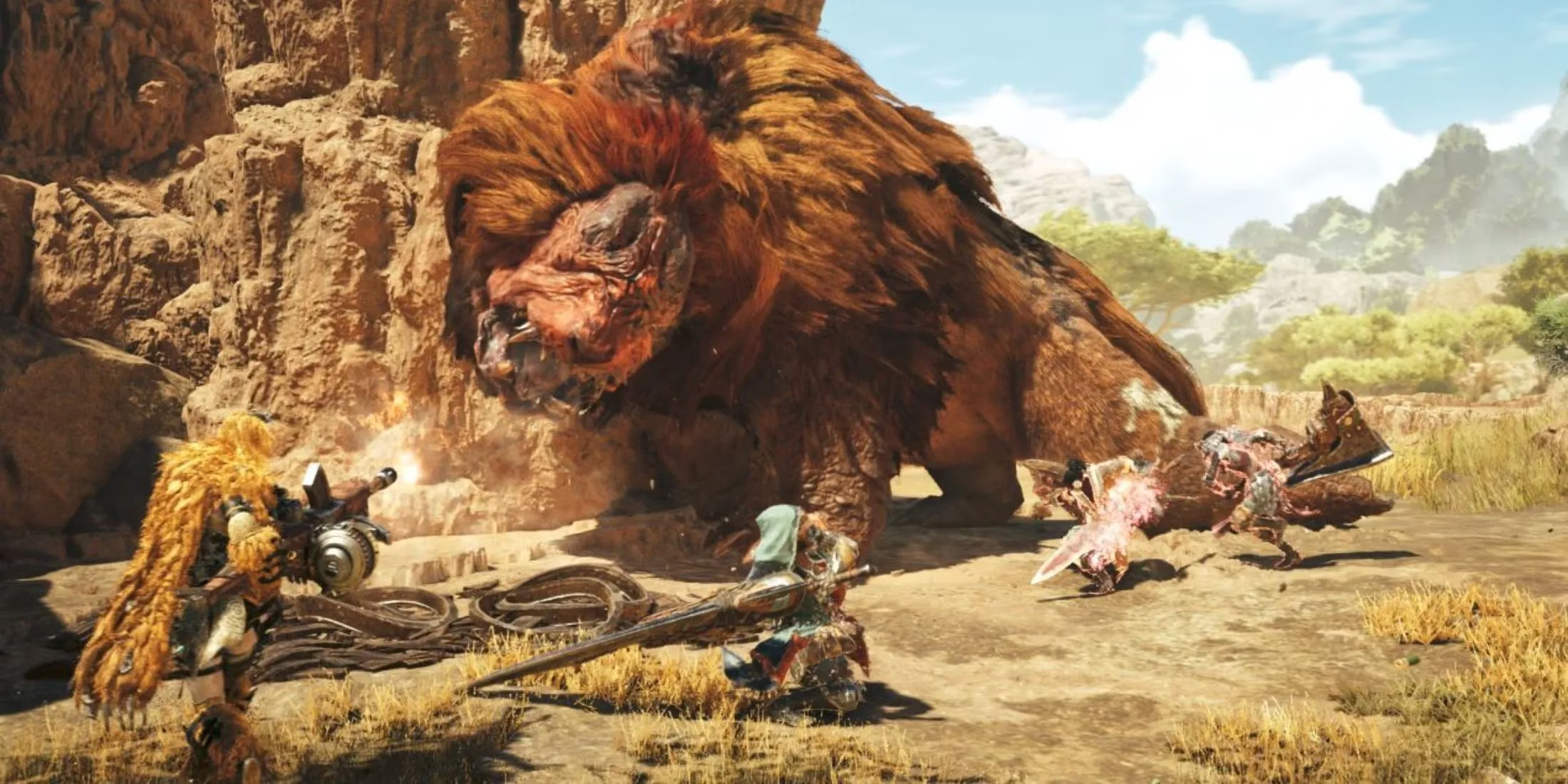
- Crossplay as Standard: In 2026, platform borders are relics. My hunting party regularly consists of a friend on a console and another on a high-end PC. The crossplay implemented at launch has proven rock-solid, making the community feel unified in a way that was once a distant dream.
Playing Wilds in 2026 feels like being part of a migratory bird flock—individually capable, but instinctively connected, sharing the load and the journey across an endless sky. The multiplayer isn't a feature; it's the very atmosphere of the game.
The Gilded Cage of Nightreign
Elden Ring Nightreign, in stark contrast, feels like exploring a beautiful, but meticulously curated, antique clock. Its mechanisms are fascinating and complex, but they operate under strict, immutable rules. The co-op experience it offers is intentional, intimate, but undeniably restrictive.
Here’s the reality of Nightreign's multiplayer in 2026:
| Feature | Monster Hunter Wilds | Elden Ring Nightreign |
|---|---|---|
| Player Session Size | Up to 100 (16 visible) | Fixed parties of 3 only |
| Cross-Platform Play | ✅ Fully Supported | ❌ Explicitly Not Supported |
| Drop-In / Drop-Out | ✅ Anytime, via SOS or invites | ❌ Must start and finish run together |
| Progression | Shared story & quest progress | Likely run-based, individual rewards |
| Offline Support | ✅ Full with NPC helpers | ✅ Solo only, scaling unknown |
The three-player co-op, while functional, requires your fellowship to be assembled before you step into the ever-shifting corridors of the Nightreign. There is no calling for help mid-crisis against a corrupted boss. If a comrade falls to connection issues—a specter that still occasionally haunts the experience—the remaining players are often left in a crippled state, their run's balance thrown into disarray. It creates a tense, high-stakes bond, but one that can feel as fragile as a spiderweb in a storm.
The lack of crossplay has Balkanized the community. My PC-bound friends inhabit a different Nightreign altogether from my console comrades. We share stories, but never the struggle itself.
The Philosophy of Togetherness
This divergence stems from core philosophy. Monster Hunter has spent a decade sanding down the rough edges of cooperation. Wilds is the culmination: a game that says, "The world is dangerous, but you never have to face it alone." Its multiplayer is a safety net woven from the threads of community.
Elden Ring Nightreign, true to its Souls lineage, sees multiplayer as a ritual. It is deliberate, fraught with potential setbacks, and designed to make victory hard-won. The connection is the challenge. This creates profound moments of camaraderie when you triumph against the odds, but it also builds walls where Wilds builds bridges.
In 2026, after countless hours in both worlds, the verdict is clear for a social hunter like me. Monster Hunter Wilds has not just maintained its advantage; it has expanded it into a whole new domain of accessible, joyful cooperation. It understands that in a modern live-service world (even without being a live-service game itself), flexibility and openness are king. Elden Ring Nightreign remains a captivating, brutal, and niche experiment—a masterpiece of atmospheric co-op for a dedicated coven, but one that asks its players to adapt to its archaic rhythms. For those of us who believe the greatest joy is in easily sharing the journey, the wilds are calling, and they are wonderfully, seamlessly, connected.