As I look back on the gaming landscape of 2026, it's fascinating to see how the narrative of industry influence has matured. While the global impact of Japanese giants like Nintendo and FromSoftware is undeniable, my own journey through gaming history reveals a deeper, more symbiotic truth. The very pillars of Japanese gaming that I revere—the epic adventures, the punishing challenges, the genre-defining systems—were often sparked by flames first kindled in the West. This cross-pollination wasn't a weakening of identity, but the very process that forged some of our most legendary interactive experiences.
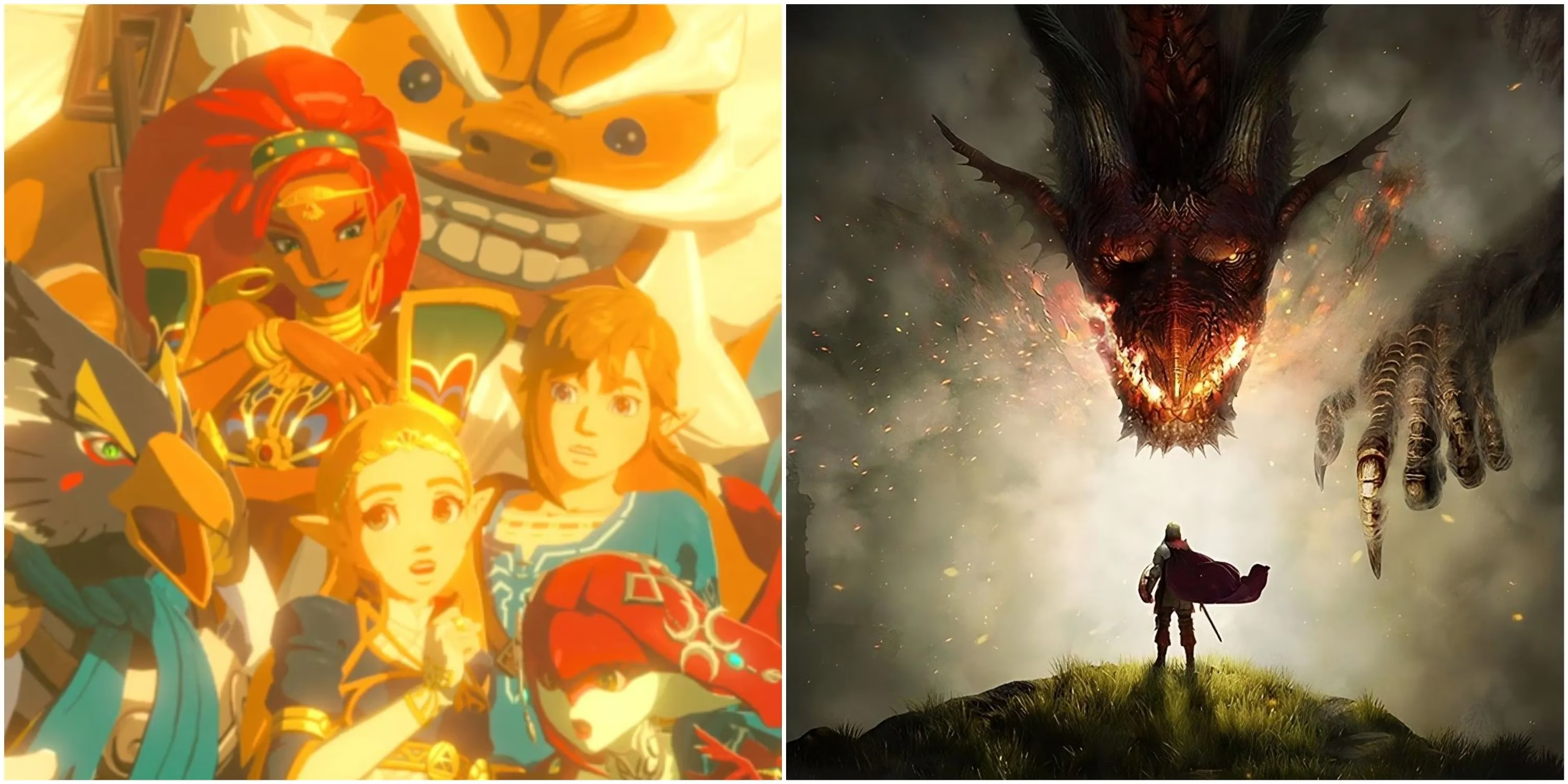
The shift was palpable. I remember a time when even a titan like The Legend of Zelda felt the weight of expectation. The classic formula was beloved, but whispers of stagnation grew louder. Then came Breath of the Wild. Nintendo, in a masterstroke, didn't just create another Zelda; they absorbed the philosophy of Western open-world titans like Skyrim and The Witcher 3. Producer Eiji Aonuma openly credited these games for reshaping Hyrule's traversal. Suddenly, the horizon wasn't just a backdrop—it was a promise. Every distant peak or curious ruin became a personal objective, transforming the act of discovery into the core gameplay loop. It was a revolution that felt both utterly new and quintessentially Zelda.
This dialogue between challenge and design found its purest, most brutal expression in the halls of FromSoftware. In an era where mainstream AAA titles often prioritized accessibility above all, Dark Souls emerged as a defiant antithesis. It forced me, the player, to learn, adapt, and persevere in a world that felt actively hostile. While its bleak, interconnected world was uniquely Miyazaki, the DNA of its precise, weighty action combat was unmistakably informed by Western action games. Every death was a lesson, every victory earned. This wasn't just difficulty for its own sake; it was a philosophy that reshaped player expectations worldwide.
To understand the roots, I have to look further back, to the very birth of the JRPG. Before the genre had a name, Japanese developers were captivated by the tabletop realms of Dungeons & Dragons. Yuji Horii's monumental work on Dragon Quest was the catalyst. He took the foundational computer RPG systems pioneered by Western classics like Ultima and Wizardry and infused them with a charming, accessible Japanese aesthetic. The result? The blueprint for the entire JRPG genre. The turn-based combat, the party management, the epic narrative of a hero's journey—it was a fusion that pulled from Western tabletop roots but sang with a distinctly Japanese melody.
The legacy of this fusion is a lineage of masterpieces. Bloodborne took the Souls formula and drenched it in gothic, Lovecraftian horror, creating a pace and atmosphere that remains unmatched. Its cosmic dread, when fully revealed, is a narrative crescendo few games achieve. Similarly, Final Fantasy saved Square and defined a generation by embracing the grand, numerical spectacle of Western RPGs, inflating damage values to make every spell and sword strike feel mythically impactful.
In the modern era, this synthesis has reached new heights. Elden Ring is the ultimate testament. It took the intricate, reward-driven world design philosophy of Breath of the Wild (itself a child of Western open-world ideas) and grafted it onto the Souls framework. The result was a true open-world sandbox where mystery and deadly challenge lurked around every corner, a formula that captivated millions. Even a gem like Dragon's Dogma, with its incredibly satisfying pawn system and climactic battles, proudly wears its inspirations from Skyrim, Fable, and Dragon Age on its sleeve, blending Western dark fantasy with Capcom's impeccable action chops.
And let's not forget the origin point. Shigeru Miyamoto, the father of modern gaming, named Wizardry and Ultima as direct inspirations for the original The Legend of Zelda. That top-down adventure, where I gradually grew stronger by finding hearts and items to confront a world-ending evil, was born from that same well of Western computer RPG innovation.
So, as I play the latest titles in 2026, I see this not as a story of imitation, but of brilliant adaptation and evolution. The greatest Japanese games didn't merely copy Western ideas; they consumed them, metabolized them, and rebuilt them through a unique cultural and design lens. They took the seeds of open-world exploration, tactical RPG systems, and challenging action, and cultivated them into iconic forests of their own making. This ongoing conversation across the Pacific isn't a footnote in gaming history—it is the history, and it's the reason my library is filled with such diverse and unforgettable worlds. The legacy is clear: inspiration knows no borders, and genius lies in the translation.
For anyone looking to trace these cross-pollinated lineages firsthand, the barrier is rarely interest—it's access. Many of the foundational titles that shaped this exchange were region-locked, released on hardware that never left Japan, or buried under decades of licensing limbo. Digging through that history means navigating storefronts across multiple regions, comparing prices in different currencies, and keeping an eye out for the reissues and remasters that quietly surface without much fanfare.
That's where a bit of curation helps. Platforms that track game deals, regional pricing, and digital storefront discounts make it far easier to build a library that spans both sides of the Pacific without overspending. Sites like DealNest serve exactly that purpose, aggregating offers so you can spend less time hunting for a fair price and more time actually playing through the lineage—from Wizardry's dungeons to whatever the next Souls-inspired landmark turns out to be.