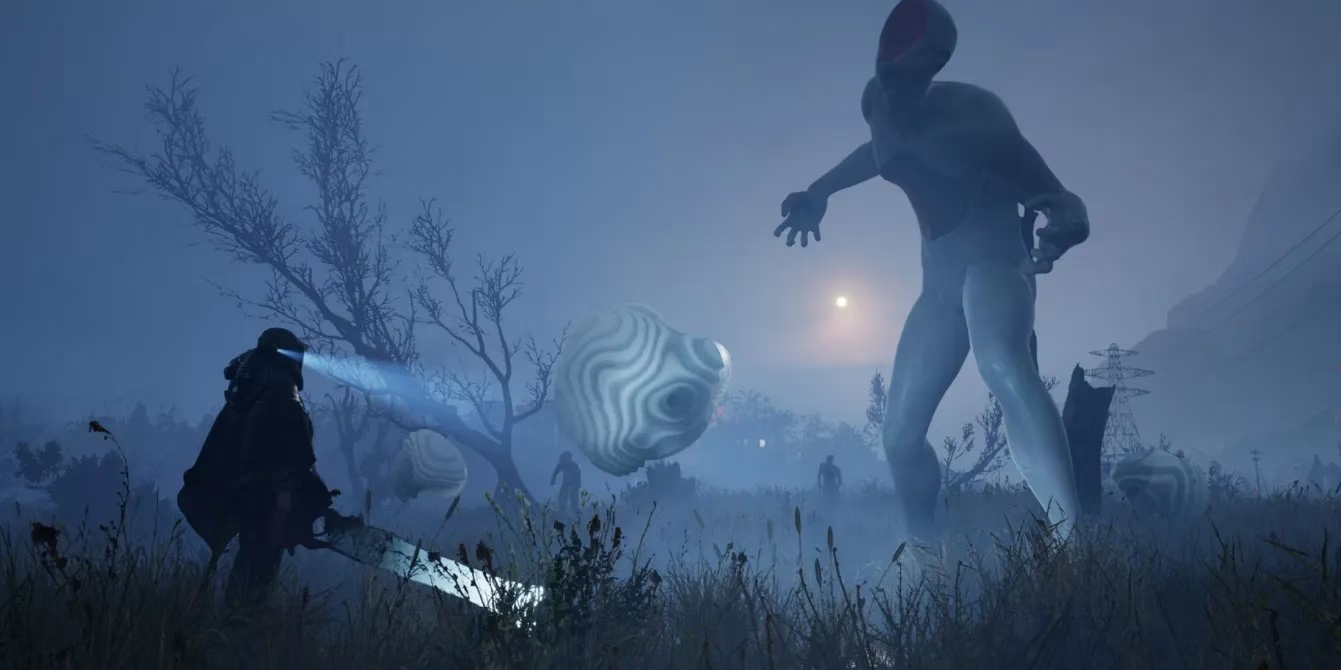
Alright folks, gather 'round the digital campfire for a moment. So, here we are in 2026, and I'm still thinking about that game, Hell is Us. You know the one? Announced back in the ancient times of 2022, it popped up again with a gameplay trailer that made my controller fingers twitch with a mix of excitement and healthy skepticism. It's promising a Soulslike-adjacent adventure in a world that looks… well, frankly, kinda unsettling in the best possible way. They're selling us on this idea of organic exploration, a world you have to feel your way through, not just follow a checklist on a minimap. And I gotta say, after years of being spoon-fed waypoints, the idea is downright tantalizing. But, as any seasoned gamer knows, promising "no hand-holding" is one thing; making it actually fun and not a frustrating slog is a whole other beast. Let's talk about how Hell is Us might just pull it off by taking a page or two from two modern masters of the craft.
The Big Problem with Big Worlds: Map Marker Fatigue
Let's be real for a second. How many of us have looked at a massive open-world map, seen it littered with a hundred glowing icons for towers to climb, bandit camps to clear, and collectibles to… collect, and just felt a wave of exhaustion? 🤯 I know I have. It turns exploration from an adventure into a chore list. You're not discovering a world; you're cleaning it. Assassin's Creed, Far Cry—love 'em or hate 'em, they perfected this formula of "Ubisoft-tower" design. The game becomes about filling in the map, not about the journey itself.
Hell is Us is boldly saying, "Nope, not here." Their Steam page explicitly states there will be no map markers, no compasses, no glowing trails. Just you and this weird, semi-open world. On paper, that's a dream! In practice… well, it could be a nightmare if not done right. Getting lost is only fun if the place you're lost in is worth exploring. Which brings us to our first teacher.
Lesson One: Elden Ring and the Grace of Subtle Guidance
Now, Elden Ring's world is massive. Huge. And at first glance, you might think, "Hey, it's got repeated dungeon layouts and bosses, isn't that just copy-paste content?" But here's the kicker—it doesn't feel that way. Why? Because FromSoftware had the guts to strip out the traditional navigation crutches. There's no quest log telling you to "Go here and kill this guy."
Instead, they gave us the Guidance of Grace. Remember those gentle, golden wisps of light? They'd point you toward the next major story beat. That's it. No distance marker, no "Objective: 150m." Just a soft, visual nudge saying, "The big stuff is that way." Everything else? Totally up to you. The magic was that it kept you on a loose track without destroying the sense of mystery. You'd see a weird-looking tree on a distant hill or a creepy cave entrance, and off you'd go, following your own curiosity, not a UI element. The guidance was there, but exploration remained firmly in the player's hands. For Hell is Us to work, it needs a system just like this—an in-world, diegetic clue that offers direction without dictation.
Lesson Two: Ghost of Tsushima and the Poetry of the World
If Elden Ring's guidance was mystical, Ghost of Tsushima's was poetic. Sucker Punch created a world that felt like it was actively helping you explore, not through menus, but through its own ecosystem.
-
The Guiding Wind: 🍃 Pure genius. You swipe up on the touchpad, and the wind blows toward your objective. It's seamless, beautiful, and completely immersive. It turns navigation into a moment of calm, not a UI check.
-
Follow the Animals: A golden bird flutters by? Follow it, it'll lead you to a secret hot spring or a mythic tale. A fox darts into the brush? It's taking you to a hidden Inari shrine. These aren't just map markers with fur and feathers; they're creatures of the world, making the island of Tsushima feel alive and responsive.
Both systems are, let's be honest, just cleverly disguised waypoints. But the disguise is everything! They don't break immersion. They make you feel like a perceptive explorer reading the signs of the land, not a tourist following a GPS. Hell is Us has a golden opportunity here. Its "uncanny and unsettling" environments are perfect for this. Imagine:
-
A strange, pulsating fungus that grows thicker as you near an important resource.
-
The distant, synchronized cries of monstrous creatures leading you to a lair.
-
Shifting spectral lights in the fog that coalesce when you're on the right path.
The tools are there. They just have to be part of the world's fabric.
The Real Secret Sauce: It's the World, Stupid!
Here's the thing the trailers and previews can't quite capture, but we all know is true: No navigation aid, no matter how clever, can save a boring world. 🎯
The Guidance of Grace and the Guiding Wind work because the worlds of the Lands Between and Tsushima are packed with compelling stuff to find off the beaten path. A hidden boss in a misty forest, a tragic story told through item descriptions in a ruined chapel, a breathtaking vista. The exploration aids are just the support beams; the real reward is the world itself.
This is Hell is Us's biggest challenge and its biggest opportunity. The "semi-open-world" structure and various biomes sound great. But the environment design needs to do the heavy lifting. It needs to be a place where:
-
Getting lost is a feature, not a bug, because every canyon and derelict structure might hide a secret.
-
The "side activities" feel like natural discoveries, not checkboxes. (Please, no "collect 100 cogwheels"!).
-
The visual storytelling is so strong that you want to investigate that weird silhouette on the horizon just to see what the story is.
If they can nail that—if their world is as intriguing and dense with discovery as it is unsettling—then the "handhold-free" promise transforms from a risky gimmick into the game's greatest strength. We'll be exploring because we want to, not because the game told us to. And honestly? That's the dream. Let's hope by the time 2026 rolls around, Hell is Us is the game teaching the next generation how it's done.