As a player, diving into a vast open world in 2026 often feels like being constantly nudged along a pre-determined path. Don't get me wrong, that guided experience has its place and works brilliantly for many titles. But, oh man, there's something truly magical about those games that toss you in the deep end, choose misdirection over hand-holding, and let genuine curiosity be your only compass. It's a vibe, a specific feeling of discovery that only comes from a world that doesn't feel the need to explain itself. Titles like Tunic, Hollow Knight, and Rain World mastered this art, and their legacy lives on in open-world designs that prioritize atmosphere and enigma over constant waypoints. It's about the journey, not just the destination, and the quiet thrill of connecting the dots yourself.
The Long Dark: A Melancholy, Quiet Mystery
Challenging, hardcore survival is the name of the game here, for sure. But what sticks with me about The Long Dark are those long stretches of true, tranquil quiet. You're tasked with scouring a frozen Canadian wilderness, taking arduous journeys across hostile terrain that feels both beautiful and utterly lonely. The environmental storytelling is everything.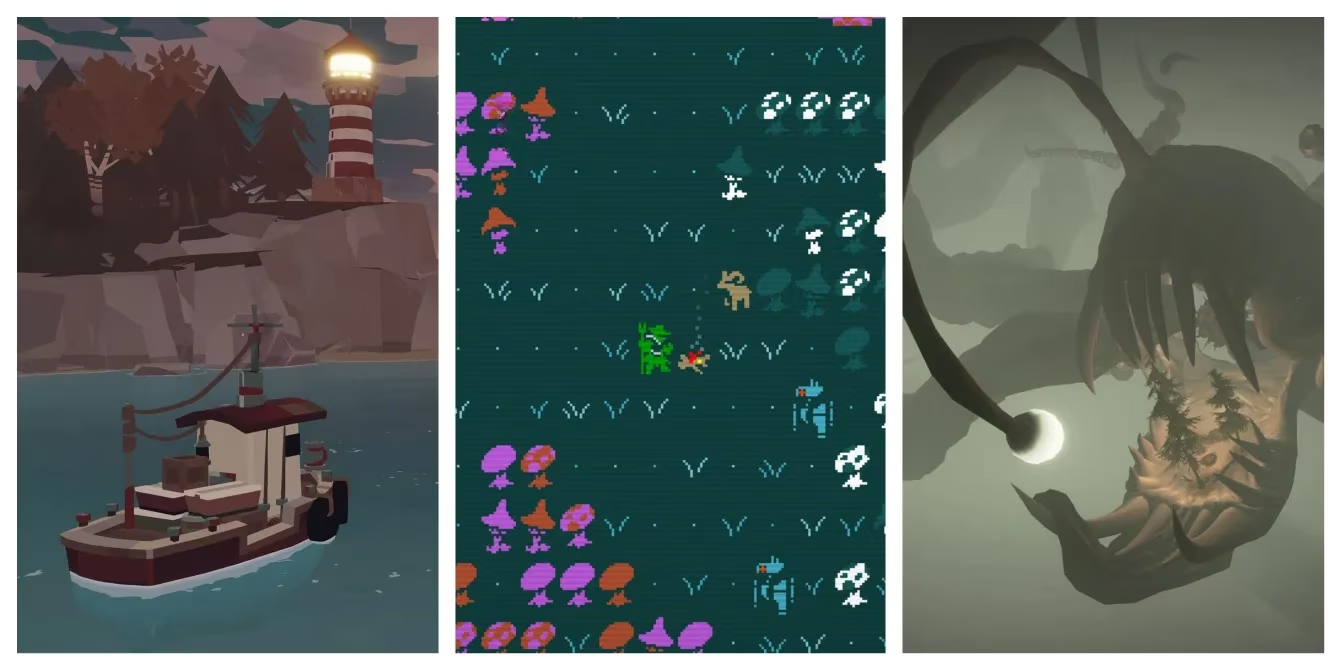
-
The Vibe: It's a deeply melancholic mystery. The classic survival mode has no explicit narrative, but the abandoned cabins, frozen corpses, and silent radio towers tell a story that's both haunting and deeply personal. There's something profoundly unsettling about the quiet—you're constantly wondering what happened here, and the game never quite gives you a straight answer. It's a mystery baked into the very atmosphere.
-
The Draw: It's the ultimate "figure it out or freeze" simulator. The mystery isn't about a grand plot, but about the land itself and your fragile place within it.
Kenshi: Find Your Own Way in a Bizarre Wasteland
If you crave pure player agency, Kenshi is your jam. This open-world sandbox RPG is a masterclass in throwing you into an utterly strange, borderline alien wasteland and saying, "Good luck, pal."
-
The Vibe: The mystery isn't supernatural; it's societal and ecological. You start as a nobody, and the rules of this world are not explained. Why are there giant, skinned beasts roaming the deserts? What's the deal with the robotic Skeletons? The struggling factions, from holy nations to cannibal hives, operate on their own bizarre logic. Learning simply how to survive—and who not to piss off—is the core mystery of the early game.
-
The Draw: The drive is 100% sheer curiosity. You see a strange spire on the horizon, and you just have to go see what it is, consequences be damned. It's a world that feels alive in its own weird, brutal way.
Dredge: A Tranquil Yet Spooky Sea of Secrets
Dredge proves that a small, focused open world can be infinitely more mysterious than a sprawling empty one. With simple controls centered on fishing and exploration, it lulls you into a sense of peace before the Lovecraftian horror seeps in.
-
The Vibe: It's quiet, minimalist, and deeply spooky. You're just a fisherman trying to make a living, but the fog hides ancient mysteries, and the fish you catch start to look... wrong. The enigmatic characters in the coastal villages drop cryptic hints, building a sense of dread that's more atmospheric than action-packed.
-
The Draw: The juxtaposition is killer. The relaxing act of fishing becomes a vehicle for uncovering a cosmic horror mystery. The game doesn't hold your hand; it lets the unsettling atmosphere and your own growing unease guide you.
STALKER: Shadow of Chernobyl: Gritty, Unpredictable Mystery
Talk about a unique vibe. STALKER: Shadow of Chernobyl combines hardcore survival FPS mechanics with one of the most authentically mysterious settings in gaming: The Zone.
-
The Vibe: It's gritty, bleak, and utterly captivating. The mystery comes from the Zone itself—a place of strange gravitational anomalies, mutated creatures, and whispered legends about a wish-granting Monolith. The AI is famously unpredictable, with factions and mutants roaming dynamically, making every expedition feel tense and uncharted.
-
The Draw: Exploration is genuinely thrilling and dangerous. You're not just following a map; you're piecing together the ecology and rules of a deadly, living environment. The sense that anything could happen is the core of its mystery.
Caves of Qud: A Roguelike of Alien Wonders
This open-world roguelike RPG is a trip. Set in a post-apocalyptic, retro-futuristic science-fantasy world, Caves of Qud is like exploring a universe dreamed up by a mad, poetic scientist.
-
The Vibe: Utterly, profoundly alien. You'll meet psychic beetles, sentient plants, and chrome-plated mutants. The combination of hand-crafted and procedural content means you're always stumbling upon the unknown. The mystery is in the world's very DNA—its history, its creatures, and its bizarre, beautiful logic.
-
The Draw: The pure, unfiltered joy of discovery. Every new screen could reveal a strange new creature, a lost piece of lore, or a terrifying threat. It demands investment and rewards it with unmatched imaginative depth.
Outer Wilds: Curiosity-Driven Cosmic Discovery
Outer Wilds is the purest expression of this concept. You're an astronaut in a tiny, doomed solar system with 22 minutes before the sun goes supernova. There's no hand-holding, no leveling up—just your curiosity, your ship's log, and a universe packed with secrets.
-
The Vibe: Awe-inspiring, poignant, and brilliantly designed. The mystery is the whole point. Why is the sun exploding? What happened to the ancient Nomai civilization? The answers are discovered through environmental puzzles, clever physics, and simply following your nose. The music and sound design elevate the mystery to something truly special.
-
The Draw: It's a game about knowledge being the only real progression. That "Aha!" moment when disparate clues click into place is unlike anything else. It's a masterpiece of trusting the player to be smart and curious.
Elden Ring: A Layered World of Hidden Depth
FromSoftware's formula found its perfect expression in the open world of Elden Ring. While known for tough combat, the real magic for me is the world itself—a strange, layered, and deeply mysterious place.
-
The Vibe: Imaginative, layered, and demanding of your attention. From the golden Erdtree to the horrors buried underground, every corner hides a secret, a tragic boss, or a piece of cryptic lore. The game's lack of quest markers or explicit direction means you forge your own path, driven by the allure of a distant castle or a hidden cave entrance.
-
The Draw: The interconnected design and the sheer density of secrets. The mystery isn't just in the story; it's in the geography. Finding a hidden elevator that plunges you into a vast, glowing underground city is a feeling of discovery that's hard to top.
Death Stranding: An Eerie Journey Through the Unknown
Hideo Kojima's Death Stranding is a mood. Its world, though composed of familiar-looking wilderness, is consistently eerie and mysterious. The long, often tranquil journeys of a delivery man are made compelling by overwhelming strangeness.
-
The Vibe: A slow-burning, baffling, and deeply atmospheric sci-fi mystery. You're dealing with invisible "BT" creatures, timefall rain, and repatriation mechanics long before the game bothers to fully explain them. The enigmatic characters (played by Hollywood stars, no less) speak in metaphors and half-truths.
-
The Draw: It's the intentional withholding of information. The game makes you sit with the mystery, making the world itself feel alien and incomprehensible. The allure is in the gradual, patient unraveling of its bizarre rules and lore. It's an acquired taste, but for those it clicks with, it's unforgettable.
In Summary: The Power of the Unexplained
In 2026, with games bigger and more detailed than ever, these titles remind us that scale isn't everything. The real magic often lies in what's not shown, what's not explained. They trade the security of a guided tour for the thrill of being an actual explorer. It's about worlds that feel like they exist beyond your screen, with their own rules and histories waiting for you to piece them together. That sense of genuine, personal discovery—of solving a mystery the game never formally presented—is a feeling that just can't be replicated. And honestly? That's what keeps me coming back for more. 😉
That hunger for discovery is exactly what pulls so many players back into these worlds, but it also means investing plenty of hours—and sometimes a little extra in-game currency to make the journey smoother. Whether you're stocking up on supplies for a long expedition in Death Stranding or giving yourself a leg up in one of Elden Ring's more punishing regions, having a quick and secure way to top up makes a real difference. That's where a platform like Lootbar comes in, offering a convenient route to game credits and digital items without the usual friction.
Because ultimately, the joy of uncovering a world's secrets shouldn't be interrupted by logistical headaches. When you're moments away from solving a long-brewing mystery or stumbling into an area no one else has charted, the last thing on your mind should be payment hurdles. So, before you set out on your next adventure, taking a moment to sort out the practical side leaves you free to focus on the one thing that truly matters: getting lost in a world that still has plenty to hide.