Soulsborne games never had traditional quests. You'd meet vague characters strewn across crumbling worlds, mumbling cryptic riddles. There were no journals or map markers, just chance encounters. The linear worlds made following their obscure stories possible. But then came Elden Ring, FromSoftware's first open-world venture, and it completely shattered that familiar, if confusing, structure. The golden guidance of grace points the way for the main story, but what about the dozens of personal, tragic, and deeply woven NPC tales? Here in 2026, as we look back on a game that defined a generation, its quest design remains a fascinating point of contention. Did its refusal to hold our hands create magic, or did it simply bury its best stories under an avalanche of obscurity? Let's dive in.
The Sellen Saga: A Masterclass in Confusion?
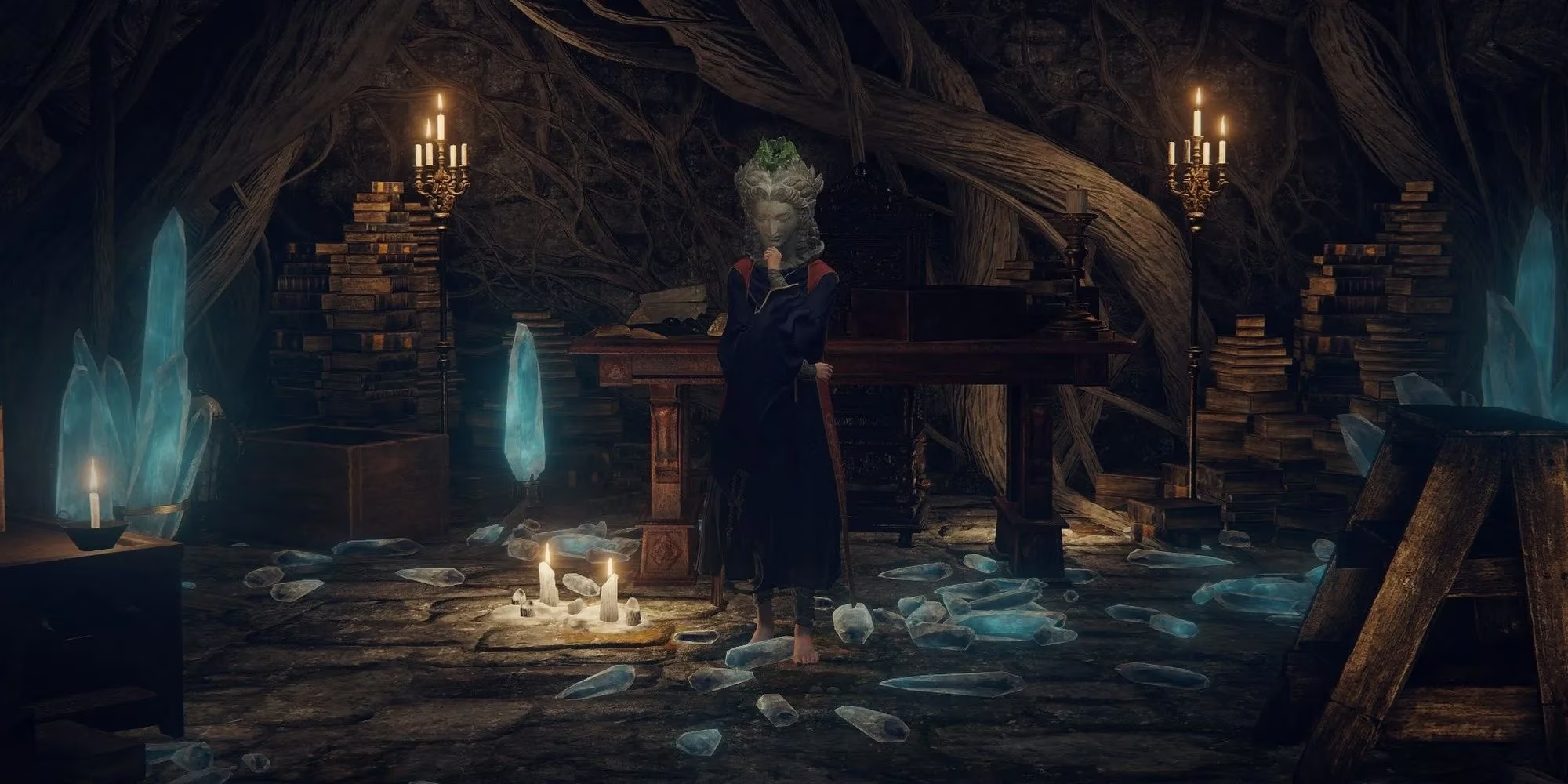
One of the most cited examples is the questline of Sorceress Sellen. It's a tragic tale of arrogance and a lust for knowledge so profound it consumes her humanity. You first find her—or rather, an illusion of her—hiding behind a Mad Pumpkin Head in the Waypoint Ruins. Her true form is later discovered shackled in the Witchbane Ruins. Sounds straightforward? Think again.
Her quest sends you on a wild goose chase across the Lands Between:
- Step 1: Find the legendary Comet Azur spell. Where is it? Oh, just at Mt. Gelmir, beyond the Altus Plateau, north of Liurnia. You need to navigate around the entire Volcano Manor to reach it. For a new player, this is like finding a needle in a continent-sized haystack.
-
Step 2: Find other sorcerers, some in Caelid. Slightly better clues, but still easy to miss.
-
The Real Kicker: To progress, you must then speak to Witch-Hunter Jerren, the guy who starts the Radahn Festival. In hindsight, it makes sense—he hunts witches, Sellen is a witch. But in the moment? These two characters feel like they belong to completely separate stories with zero obvious connection. The game provides no breadcrumb trail linking them.
The lack of linearity in this massive world makes piecing together these steps a monumental task. You're not just following a path; you're conducting a continental-scale investigation with no notes. Is this brilliant environmental storytelling, or is it just bad design?
The Sheer Volume Problem: 29 Threads to Juggle
It's not just the complexity of individual quests; it's the sheer number of them. In a recent 2026 playthrough aiming for 100% completion, I tackled all 29 NPC questlines, including those tied to endings. Characters like Boc the Seamster, Diallos, Jar-Bairn, and Nepheli Loux have deep, moving stories that are incredibly easy to miss or irrevocably break by progressing too far in another area.
How did I manage it? Let's be real—with an online checklist. There was no other way. The game provides no internal log, no record of conversations, nothing. I had to manually track:
-
Who I spoke to and what they said.
-
Which items I needed to find and where.
-
The exact order of operations to avoid locking myself out of endings.

Is this engaging? For some, yes. It creates a community-driven experience where players share discoveries. But for the average player just trying to experience the story? It's a barrier. Director Hidetaka Miyazaki once said he'd feel the game had failed if players needed guides. For the critical path, guided by grace, it succeeded. But for NPC quests? In 2026, we can confidently say: it absolutely, unequivocally failed by that metric. The stories are there, but the game does almost nothing to help you find them.
What Could FromSoftware Learn for the Next Open World?
As we speculate about FromSoftware's future after the monumental success of Elden Ring and its DLC, one question looms: how should they handle quests in another open world?
The core Soulsborne quest structure—vague, character-driven, and easy to miss—clashes fundamentally with the freedom of an open world. In a linear game, you will bump into the NPC again. In an open world, you might never return to that corner of the map. The solution doesn't have to be a sky-full of map markers or a journal that spells everything out.
Imagine a simple, elegant compromise:
-
A Dialogue Log: Just a record of key conversations you've had. No objectives, no markers, just the words. This alone would cut through so much noise. "Ah, Sellen mentioned Azur was at Mt. Gelmir. Right."
-
Character-Specific Hints on the Map: After speaking to an NPC, perhaps a subtle, non-intrusive icon appears in the region they mentioned, only after you've discovered that region yourself. It respects discovery while offering a nudge.
Conclusion: Buried Treasure, or Just Buried?
Elden Ring tells some of the most personal, poignant, and tragic stories in gaming. The tale of Millicent's choice, the heartbreaking journey of Alexander the Iron Fist, the redemption of Nepheli Loux—these are narrative gold. But they are buried treasure with a map written in invisible ink.
In 2026, the debate rages on. Purists argue that the obscurity is the magic, that the joy is in the communal discovery. Others, having missed these stories entirely on their first playthrough, feel robbed of the game's best content. The truth likely lies in the middle. The quests are masterfully written but masterfully hidden—perhaps too well.
The problem isn't that Elden Ring is too hard; it's that its communication for side narratives is non-existent. Open-world games solved this decades ago with systems that balance guidance and freedom. FromSoftware's next open-world journey doesn't need to abandon its soul. It just needs to learn that in a world this big, sometimes you need to leave a few more breadcrumbs—or at least let us remember the crumbs we've already been given. After all, what's the point of crafting such incredible stories if the only way to see them is to follow a guide written by someone else? 🤔