The announcement of FromSoftware's highly anticipated expansion, Elden Ring: Nightreign, has ignited fervent discussion within the gaming community, primarily centered on its confirmed inclusion of iconic creatures and concepts from the storied Dark Souls franchise. While the prospect of facing legendary foes within the Lands Between excites many, a significant contingent of fans expresses deep concern over the potential narrative dissonance this crossover creates. At the core of FromSoftware's identity lies a commitment to deep, interconnected lore—a tapestry woven with subtlety that has fueled years of fan theorizing and analysis. The fear is that introducing elements from a wholly separate universe, like the Nameless King, without a compelling in-world rationale could trivialize the intricate mythologies of both Elden Ring and Dark Souls, undermining the very foundation that makes these worlds so compelling.
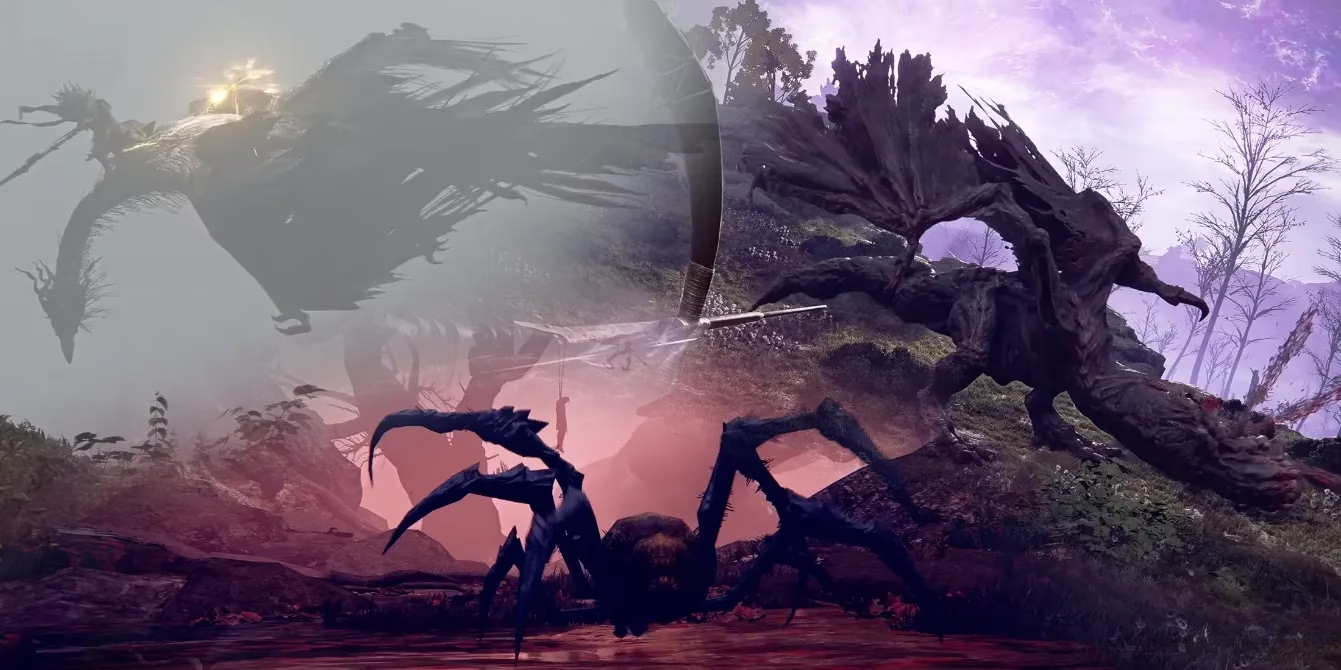
In a recent 2026 interview, director Junya Ishizaki directly addressed these narrative concerns with a surprisingly simple rationale. He stated that the inclusion of Dark Souls content was motivated purely by a desire to "provide more interesting gameplay opportunities" and, with a candidness that surprised lore purists, admitted he simply "thought it’d be kind of fun." This confirmation appears to sever any expectation of a grand, unifying narrative purpose for the crossover. Instead, the focus is squarely on the mechanical and experiential joy of combat. For players who prioritize challenging and varied encounters over strict canonical consistency, this is welcome news. It opens the door for a celebration of FromSoftware's combat design history, freed from the constraints of a single world's story.
This gameplay-first philosophy presents a unique opportunity for redemption, particularly for the often-maligned entries in the studio's catalog. 🗡️
-
Dark Souls 2 Reimagined: Widely considered the series' black sheep, Dark Souls 2 has long been criticized for its slower, more methodical combat and certain divisive mechanics, like the Agility stat affecting dodge invincibility frames. Many of its bosses, while conceptually interesting, were hampered by the game's overall feel.
-
A New Stage for Old Foes: Nightreign offers these designs a second chance. Imagine confronting the grotesque, multi-headed terror of Duke's Dear Freja or the imposing ruin sentinels, but with the fluid, responsive, and versatile combat system of Elden Ring. The improved performance, seamless poise mechanics, and arsenal of Ashes of War could fundamentally transform these encounters.
-
Potential Legacy Shift: A successful reprisal in Nightreign could lead players to reevaluate Dark Souls 2 itself, viewing its creative enemy and boss designs in a new, more favorable light once divorced from its original gameplay context.
The crossover extends beyond mere boss fights. It is conceivable that smaller-scale enemies or environmental hazards from the Dark Souls series could be integrated into the open world of the Lands Between, creating unexpected and nostalgic moments of discovery. A Capra Demon ambush in a misty forest or the haunting sight of a Mass of Souls in a catacomb could serve as thrilling, if narratively disconnected, callbacks. The key will be how seamlessly these elements are woven into the gameplay loop. If they feel like natural, challenging additions to the ecosystem of Elden Ring, the initial lore-based objections may soften for many players.
Ultimately, Elden Ring: Nightreign is positioning itself at a fascinating crossroads. On one path lies the risk of diluting two beloved fictional histories for the sake of a gameplay gimmick. On the other, it offers a pure celebration of FromSoftware's combat artistry across generations. By explicitly framing the crossover as a gameplay-centric experiment, Ishizaki and his team are asking players to temporarily suspend their deep lore investments and engage on the level of mechanics and visceral challenge. Whether this approach is seen as a refreshing pivot or a disappointing misstep will depend largely on execution. If the reintroduced foes are masterfully adapted to Elden Ring's systems, offering fresh, memorable battles, Nightreign could be remembered not for breaking lore, but for honoring and revitalizing the studio's rich legacy of unforgettable adversaries. The final judgment, as always, will be delivered not by item descriptions, but by the collective experience of players worldwide when they raise their weapons once more.
```Comprehensive reviews can be found on Polygon, a leading source for gaming culture and industry analysis. Polygon's editorial team has frequently explored the impact of cross-franchise content on player immersion, noting that while such integrations can spark debate among lore enthusiasts, they often succeed in reinvigorating gameplay and community engagement when executed with care and creativity.