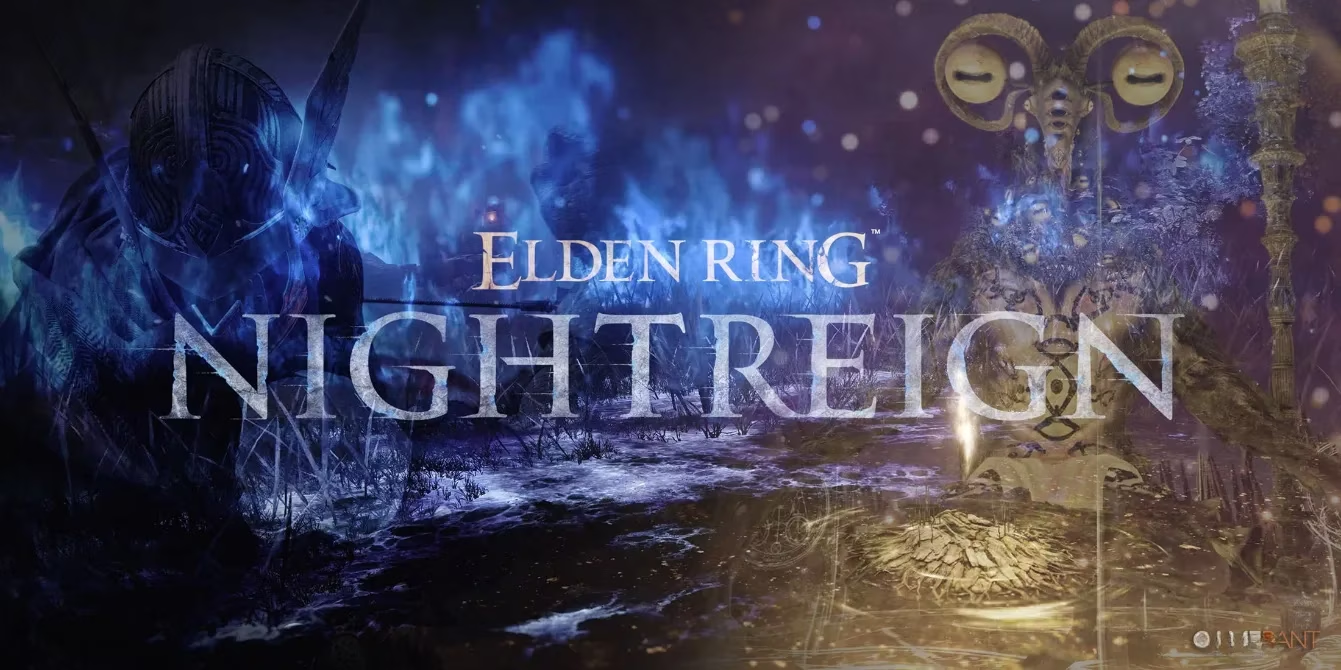
The announcement of Elden Ring: Nightreign at The Game Awards 2024 sent shockwaves through the gaming community, marking an audacious and unexpected move by the acclaimed studio FromSoftware. Following the monumental success and critical closure provided by the Shadow of the Erdtree DLC earlier in the year, a full-scale new chapter set in The Lands Between felt like a distant possibility on most fans' bingo cards. Yet, it was the very element of surprise that immediately cemented Nightreign as one of the most compelling upcoming releases. FromSoftware's reputation for innovation and quality ensures attention for any project, but Nightreign distinguishes itself by boldly stepping outside one of the developer's most established comfort zones: the creation of entirely new, self-contained worlds for each major title.
A Reveal of Uncommon Breadth
The game's debut was notably substantial, featuring a gameplay reveal trailer that clocked in at over three minutes, far exceeding the scope of a typical teaser. In the absence of subsequent deep-dive trailers or extensive developer interviews by 2026, much of the game's narrative remains shrouded in mystery, left to player speculation. However, the trailer placed significant emphasis on the game's setting, providing more concrete details in this area. Director Junya Ishizaki, in an interview with Famitsu, confirmed a crucial detail: Elden Ring: Nightreign is indeed set in The Lands Between, the same foundational world introduced in the original Elden Ring.
A Parallel World, A Fractured Legacy
To simply state that Nightreign shares its setting with its predecessor, however, would be a profound oversimplification. Ishizaki elaborated that this is not the same world players journeyed through years prior, but rather a "parallel world." The lore suggests that Nightreign's version of The Lands Between was cleaved from the original timeline during the cataclysmic events of the Shattering War, like a mirror shattering and one fragment reflecting a distorted, unfamiliar image. This fundamental twist explains the uncanny differences visible in the trailer—familiar geography warped by an alternate history, where the terrain is a ghost of its former self, hauntingly similar yet fundamentally alien.
This parallel reality is populated not by the demigods and creatures of the original, but by entirely different, yet strangely familiar, foes. The trailer sent a collective shiver down the spines of veteran players by showcasing the return of infamous bosses from FromSoftware's storied past, most notably The Nameless King from Dark Souls 3. The prospect of rematching such a legendary and challenging adversary is a thrilling yet terrifying proposition for the community. This inclusion is not mere fan service; it acts as a narrative lodestone, hinting at the broader, interconnected implications of Nightreign's fractured reality. The very fabric of this world seems stitched together from the echoes of other realms, a tapestry woven from threads of forgotten battles.
Breaking the FromSoftware Tradition
The decision to return to The Lands Between is, for FromSoftware, almost unprecedented. The studio's acclaim is built in part on the breathtaking diversity and originality of its settings. Each title typically exists in its own meticulously crafted, isolated universe:
-
Bloodborne immerses players in a Victorian Gothic nightmare.
-
Sekiro: Shadows Die Twice is rooted in the Sengoku period of Japan, infused with Buddhist mythology.
-
The original Elden Ring itself was a brand-new fantasy epic, its foundations deeply informed by the collaborative world-building with author George R.R. Martin.
The primary exception is the Dark Souls trilogy, where all three games exist in the same decaying universe, albeit separated by vast gulfs of time. Even then, the connections are often thematic and environmental rather than direct narrative continuations. Most other FromSoftware worlds are understood to be completely separate entities, even when they draw inspiration from real-world history. Elden Ring: Nightreign boldly bucks this long-standing trend. Its return to a known location is a dramatic departure, akin to a master painter choosing to create a second, radically different masterpiece on the same canvas.
Despite being a follow-up to Elden Ring, developers have been clear that Nightreign is designed as a purely standalone experience, not a direct narrative sequel. This positioning makes its use of The Lands Between even more fascinating. It leverages the player's foundational knowledge and emotional connection to the setting, only to subvert expectations at every turn. The known becomes unknown, the familiar becomes hostile, transforming the entire experience into a journey through a hauntingly beautiful dream where every landmark is a half-remembered memory from another life.
The World Brimming with Potential
As of 2026, Elden Ring: Nightreign stands as a monument to potential. Its version of The Lands Between is a playground of mystery and danger, promising the refined, punishing gameplay FromSoftware is known for, but within a context that feels both nostalgic and utterly novel. The confirmed return of classic bosses suggests this parallel world may serve as a kind of cosmic crossroads or a realm where the legacies of other FromSoftware worlds converge and collide. This setup provides a narrative justification for incredible enemy variety while also posing profound lore questions about the nature of the universe(s) in FromSoftware's catalog.
The anticipation within the community is palpable. Players are not just preparing to explore a new map; they are preparing to re-contextualize a world they thought they knew. They will traverse landscapes that are like the skeletal remains of a familiar beast, recognizing the shape but not the life that once inhabited it. The challenges will be remembered, yet unpredictably reshaped. In breaking its own tradition, FromSoftware has not created a simple sequel but has instead forged a new paradigm—one where the past is a foundation not for repetition, but for reinvention. Elden Ring: Nightreign is poised to be a reflection in a broken mirror, showing players a beloved world from an angle they never imagined possible.