In 2026, the gaming landscape continues to be shaped by bold experiments, and FromSoftware's 'Elden Ring: Nightreign' stands as a fascinating pivot. While the original Elden Ring revolutionized open-world design by stripping away traditional guidance—no objective markers, no map-cluttering towers, just the pull of distant, intriguing landmarks—Nightreign takes a different route. This new mode, blending roguelite mechanics with battle royale tension, necessitates a more direct approach to navigation. The slow, contemplative exploration of the Lands Between is replaced by the frantic pace of Limveld, where a constricting Ring of Fire forces quick decisions. Consequently, every point of interest on the map is clearly marked from the moment you drop in. This isn't a concession to hand-holding; it's a fundamental redesign for a faster, more strategic team-based experience.

Strategic Planning from the Get-Go 🗺️⚡
Gone are the days of wandering aimlessly toward a shimmering tree or mysterious castle. In Nightreign, victory hinges on instant coordination. Upon landing in Limveld, you and your team must immediately open the map and formulate a plan. The game presents a critical risk-reward loop from the start:
-
High-Risk, High-Reward: Venture toward the dangerous outskirts within the encroaching Ring of Fire to find upgrade materials for your healing flask.
-
Boss-Rush Strategy: Push inward early to challenge bosses, securing powerful loot and Runes but potentially missing key upgrades.
The default map markers are essential for this high-stakes calculus. Without them, teams would waste precious seconds—or minutes—simply figuring out where to go, inevitably getting swallowed by the deadly circle. This design ensures the focus remains on execution and combat strategy, not on basic orientation.
Seamless Co-op & Communicative Map Pins 🤝
Nightreign's headline feature is its seamless cooperative play, a first for the Soulsborne series. This innovation extends to how players interact with the world map, fostering teamwork even without voice chat. The system is elegantly simple:
-
Any player can place a marker on a point of interest.
-
If a teammate marks the exact same location, the icon changes color, turning 'white'.
-
This white pin acts as a silent consensus, a clear signal that the team is aligned on that objective.
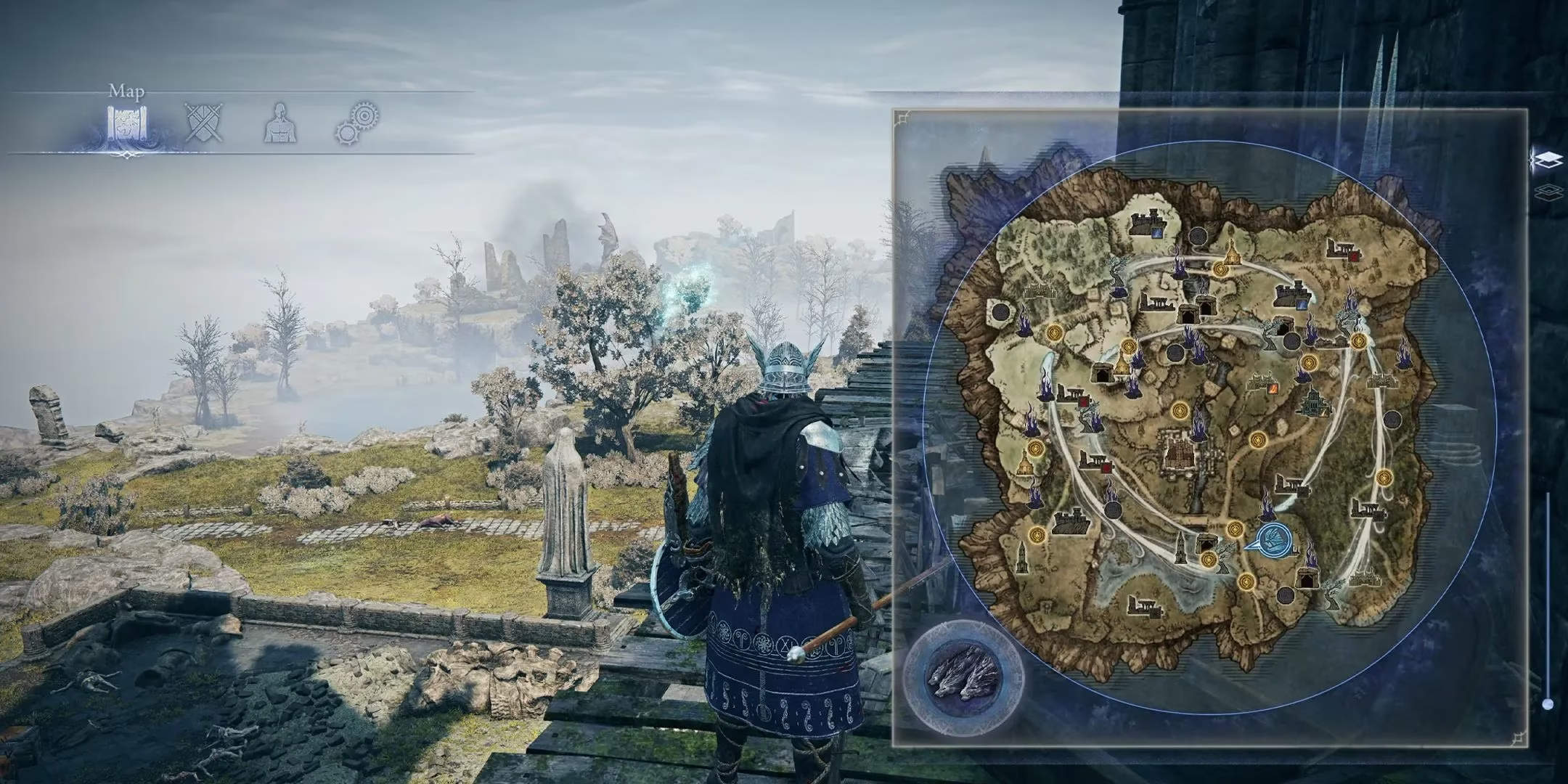
This feature is a game-changer, especially when playing with strangers. It transforms the map from a static guide into a dynamic communication tool. A cluster of white pins around a boss arena? That's the team's battle plan. A single white pin on a remote ruin? Someone has spotted a crucial item. It's non-verbal coordination at its finest, perfectly suited to the game's intense pace.
The Death of Fast Travel & The Importance of Movement 🏃♂️🔥
In another significant departure from the base game, Nightreign removes the ability to fast travel between Sites of Grace. Given the much smaller (and ever-shrinking) map scale of the Limveld arena, this change makes perfect sense. It reinforces the core gameplay loop: constant, deliberate movement is paramount. You can't teleport away from the Ring of Fire; you must outrun it. You can't warp to a missed upgrade; you must plan a route that loops back to it, weighing the risk against the shrinking safe zone.
Furthermore, interacting with a Site of Grace is streamlined. Simply getting close to one automatically triggers its benefits—fully restoring your Health and FP (Focus Points). This small quality-of-life improvement keeps the action flowing. There's no animation or menu navigation; it's a quick touch-and-go system that respects the player's time and the mode's relentless rhythm.
To summarize the key shifts in Nightreign's design philosophy:
| Feature | Elden Ring (Base Game) | Elden Ring: Nightreign |
|---|---|---|
| Exploration | Organic, curiosity-driven | Structured, objective-focused |
| Map Guidance | Minimal, environmental clues | All points of interest pre-marked |
| Co-op Communication | Limited (summoning signs) | Advanced (shared, color-changing map pins) |
| Fast Travel | Available between Graces | Disabled |
| Grace Activation | Requires interaction | Proximity-based, automatic |
| Core Pressure | Personal challenge, discovery | Time (encroaching circle), team strategy |
Ultimately, Nightreign isn't just a new mode; it's a masterclass in adapting a beloved formula for a different genre. It takes the foundational combat and world-building of Elden Ring and re-contextualizes it within a framework that demands speed, teamwork, and strategic foresight. By making the map a central tool for planning and silent communication, and by removing the safety net of fast travel, it creates a uniquely tense and cooperative Soulslike experience. It proves that even in a world built on mystery and solitude, there's thrilling potential in clear markers and shared objectives under a ticking clock. 🕐💀