What is the true face of glory before it is claimed by ruin? I walk the fractured Lands Between in 2026, my mind echoing with tales of a warrior king now lost to shadow. In every crumbling chapel and upon every weathered plinth, I see his ghost—not the shattered husk hammering hopelessly at the broken Elden Ring, but the legend that once was. They spoke of flaming red hair, a stoic bearing, and an unshakeable will that embodied the Golden Order itself. Yet, all I have ever met is a creature of writhing darkness, a testament to a restoration that broke the restorer. Is this the inevitable end of all order, to become a mindless reflection of its own failure?
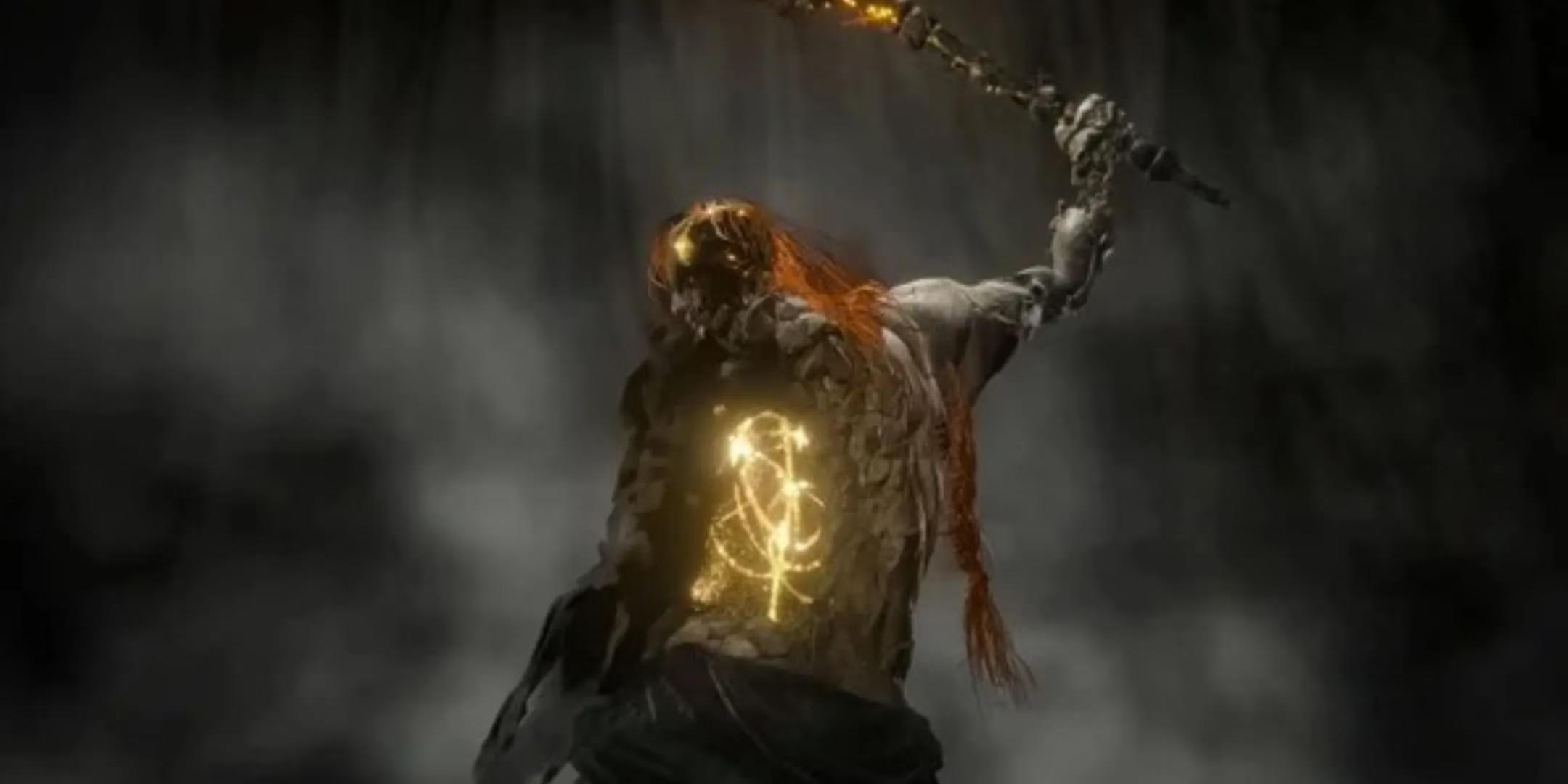
This haunting dichotomy between memory and reality is what compels the soul to dream. Recently, a fellow Tarnished, an artist of remarkable vision, shared a creation that felt like a balm on an old wound: a model of Radagon as he was before the Shattering. To see him restored—whole, proud, arms steadfastly at his sides in that iconic, determined pose—was to witness a ghost given form. It was more than a mere character model; it was an act of remembrance, a defiance against the decay that defines our age. It answered a question I had carried since first witnessing his broken form: What majesty was sacrificed on the altar of repair?
The Fallen Pantheon: Shadows of What Once Was
Radagon's tragedy is but one verse in a grand, sorrowful epic. We wander a world sculpted by FromSoftware, a civilization in its final, gasping breaths. His other half, Queen Marika, the divine architect of the Shattering, now exists as a paradox: eternally imprisoned within the very Erdtree she sought to rule, a monument to her own transgression. Their children, inheritors of a broken legacy, are themselves icons of glorious ruin:
-
Malenia, the Severed: The undefeated swordswoman who blossomed into a goddess of Scarlet Rot. Her legendary clash with Starscourge Radahn in the wastes of Caelid was a battle of titans that left one a mindless constellation-hunter and the other a slumbering vessel for decay. Where is the victory in such a draw?
-
Ranni the Witch: In the wake of Godwyn's death, she performed the most profound renunciation, casting aside her Empyrean flesh. Now she inhabits the form of a doll, a chilling replica of the Snow Witch who taught her to fear the dark moon. We find her original body, a mere glimpse, boasting the fiery red hair of her father Radagon—a single, poignant clue to the beauty she sacrificed for her lunar destiny.
-
Godwyn the Golden: The first to fall, and in many ways, the most tragic. His death marked the true beginning of the end. We have never truly seen him. He is a mystery wrapped in deathroot, perceived only in vague, obscured glimpses or as the horrific, malformed face of death itself, spreading through the very roots of the world. What noble visage was lost to create that primeval nightmare?
The artist's promise to "may make others" like their restored Radagon sends a thrill of anticipation through me. Could we one day see the full, tragic gallery?
| Character | State in 2026 | Glimpse of the Past |
|---|---|---|
| Radagon | A shattered, shadow-bound husk | Stoic warrior, red hair, symbol of Order |
| Marika | Eternal prisoner within the Erdtree | The divine ruler who shattered the world |
| Malenia | Sleeping goddess of Rot in Haligtree | The undefeated Blade of Miquella |
| Ranni | A spirit inhabiting a doll's body | Corpse with Radagon's red hair |
| Godwyn | A death-spreading monstrosity in the roots | Known only as "the Golden" |
The Weight of Memory in a Shattered World
Why does this pursuit of "before" images move me so deeply? In a land defined by aftermath, these restored visions are not mere nostalgia; they are essential context. They are the "why" to the current "what." Seeing Radagon whole makes his broken, relentless hammering not just a boss fight, but a profound tragedy. It transforms him from a obstacle into a elegy. The same would be true for Marika, Malenia, or Godwyn. To see their intended glory is to fully measure the depth of their fall and the catastrophic scale of the Shattering. It allows us to mourn what was lost, not just conquer what remains.
As I traverse the Altus Plateau, gazing upon yet another statue of Radagon in his resolute pose, the artist's creation superimposes itself over the stone. For a moment, the green-gold light of the Erdtree doesn't feel like the glow of a stagnant order, but like a spotlight on a stage waiting for its hero to return. Of course, he never will. That is our curse and our purpose. We are the Tarnished, navigating the ruins of dreams greater than our own. But through acts of artistic restoration like this, we do not just reclaim fragments of the Elden Ring—we reclaim fragments of the story, piecing together the epic poem of this world in all its heartbreaking, glorious detail. The shadows may writhe where limbs once were, but memory, it seems, can still forge a worthy likeness.