The Lands Between continue to inspire profound creativity years after the game's release. In 2026, the community's fascination with the demigods of the Golden Lineage remains undimmed, as evidenced by a stunning piece of fan art that has resurfaced and captivated a new generation of Tarnished. This artwork, originally shared by a Reddit user known as bIank_1, dares to imagine two of the most enigmatic and pivotal characters, Ranni the Witch and Rykard, Lord of Blasphemy, not as players encounter them in-game, but in their speculated original, humanoid forms before their respective transformative fates.
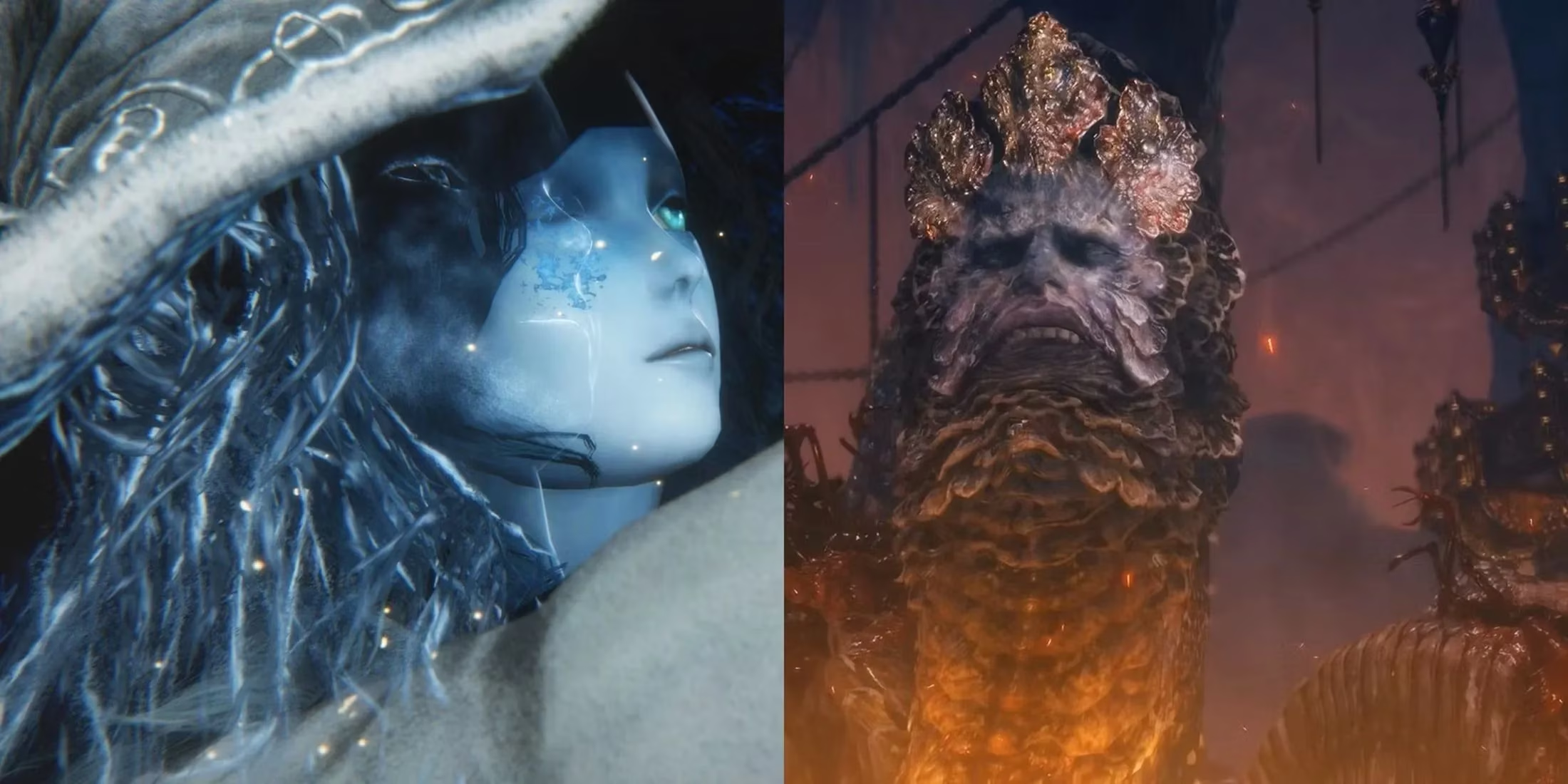
The artwork presents a scene dense with narrative implication, depicting a moment of conspiratorial alliance between the siblings. Ranni, portrayed with long, flowing red hair—a stark contrast to the four-armed doll body she inhabits—is shown bestowing the  Blasphemous Claw upon her brother. This artifact, engraved with the destructive Rune of Death, is not merely a gift but a loaded weapon, symbolizing Ranni's calculated plan to arm Rykard with a tool capable of challenging
  Maliketh, the Black Blade, the fearsome guardian of Destined Death. Her ornate blue robe, accented with crimson details, flows around her like a midnight river under a full moon, while her brother stands before her, a figure of immense, pre-corruption power.
Rykard is rendered as a towering, formidable presence, a far cry from the grotesque serpent-god amalgamation players battle in  Mt. Gelmir's Volcano Manor. He possesses the same fiery red hair, glowing eyes that hint at an inner, unquenchable ambition, and a thick beard that frames a face yet untouched by the devouring serpent. His posture and aura in the art suggest the lord he once was, a demigod whose quest for immortality would eventually lead him to become one with a primordial beast—a fate that turned him into a two-phase boss fight and the source of the mighty
  Blasphemous Blade.
The Lore Behind the Vision
This artistic interpretation is not mere fancy but is rooted in the rich, fragmented lore that FromSoftware is renowned for. The siblings are children of the complex union between  Radagon of the Golden Order and
  Rennala, Queen of the Full Moon. Their stories are interwoven with the shattering of the Elden Ring itself.
-
Ranni's Path: To defy the Greater Will and escape her destined Empryean fate, Ranni orchestrated the Night of the Black Knives, using a fragment of the Rune of Death to slay her own empyrean body while her soul fled into a handmade doll. This act is the cornerstone of her lengthy and beloved questline, which begins for players after conquering
 Caria Manor and its guardian,
  Loretta, Knight of the Haligtree, granting access to
  Ranni's Rise.
 -
Rykard's Descent: Driven by a hunger for power and eternal life that burned like a forge within him, Rykard allowed himself to be consumed by the ancient serpent, the God-Devouring Serpent. This blasphemous fusion was his answer to challenging the gods, transforming him into the monstrous boss residing in Volcano Manor, whose defeat yields the
 Remembrance of the Blasphemous.
The fan art captures a hypothetical moment before these radical transformations, a secret pact between siblings whose methods diverged as wildly as their final forms. Ranni's scheme was one of subtlety and shadow, a plot woven with the precision of a master watchmaker, while Rykard's was a path of grotesque, all-consuming defiance.
Community Resonance and Artistic Merit
The artwork sparked significant discussion upon its sharing, amassing thousands of upvotes and praise for its design and lore-accurate sensibilities. Fans debated everything from the familial resemblance in their red hair to playful critiques about Ranni's depicted height. It serves as a powerful testament to how Elden Ring's narrative, told through implication and item description, actively encourages communal interpretation and creativity.
Such pieces allow the community to visualize the "what was" before the "what is" of the game's ruined world. Seeing Rykard as a noble, if intimidating, lord rather than a screaming monstrosity adds a layer of tragic pathos to his character. Similarly, envisioning Ranni with her original fiery hair, before her spirit was transplanted into a cold, doll-like vessel, underscores the profound personal sacrifice she made for her goal of a free, starlit age. Her original form, as imagined here, is as elusive and captivating as a forgotten melody, hinting at the person lost to achieve god-slaying ambition.
In an era where the game's legacy is cemented, this fan art stands as a brilliant example of how player engagement extends far beyond gameplay. It is an act of narrative archaeology, piecing together clues from a shattered history to render a vivid, poignant portrait of two demigods at a crossroads, forever frozen in a moment of collaboration before their destinies diverged into legend and nightmare.