As a dedicated player who has spent countless hours traversing digital landscapes, I can say that the true soul of a role-playing game often lies not in its main quest, but in the freedom it grants me to wander, discover, and make the world my own. In 2026, looking back at the classics and forward to new horizons, the RPGs that have left the most indelible mark on my memory are those that mastered the art of exploration. They are the games where the journey itself became the destination, where a hidden path, a forgotten ruin, or a chance encounter could tell a story more compelling than any scripted plot. This sense of boundless discovery is what transforms a good RPG into a legendary one.
The Timeless Legends: Worlds That Defined Freedom
Even years after their release, some games remain the gold standard for exploration, their worlds as captivating today as they were upon launch.
The Elder Scrolls V: Skyrim stands as a monument to player agency. From the moment I escaped Helgen, the entire province was my oyster. The genius of Skyrim wasn't just its size, but its density. Every mountain peak seemed to hide a dragon's lair, every forest path led to a bandit camp or a hunter's cabin. The exploration was self-directed and deeply personal; I created my own stories simply by choosing a direction and walking. It’s the prime example of a world that feels truly alive and waiting to be discovered.
Similarly, The Witcher 3: Wild Hunt masterfully structured its freedom. Traveling with Geralt through the war-torn swamps of Velen, the bustling streets of Novigrad, and the windswept cliffs of the Skellige Isles felt like exploring distinct countries, each with its own mood, mysteries, and moral complexities. Exploration here was never just sightseeing; it was investigation. A question mark on the map could lead to a heartbreaking side quest, a deadly monster contract, or a piece of gear that changed my entire build. The world was a tapestry of stories, and exploration was the thread that wove them all together.
The Modern Masters: Evolving the Art of Discovery
The last decade has seen developers refine the concept of exploration, blending open spaces with intricate design and meaningful consequences.
Elden Ring redefined the open world for a generation. FromSoftware took its legendary sense of mystery and scale and unleashed it upon The Lands Between. The exploration here was organic and often perilous. There was no checklist of points of interest—just a hauntingly beautiful landscape begging to be understood. I remember cresting a hill in Liurnia and seeing the glowing academy in the distance, or descending into the terrifying depths of Siofra River. The game rewarded my curiosity with awe-inspiring vistas, devastating secrets, and some of the most challenging enemies in gaming. The danger made every discovery feel earned.
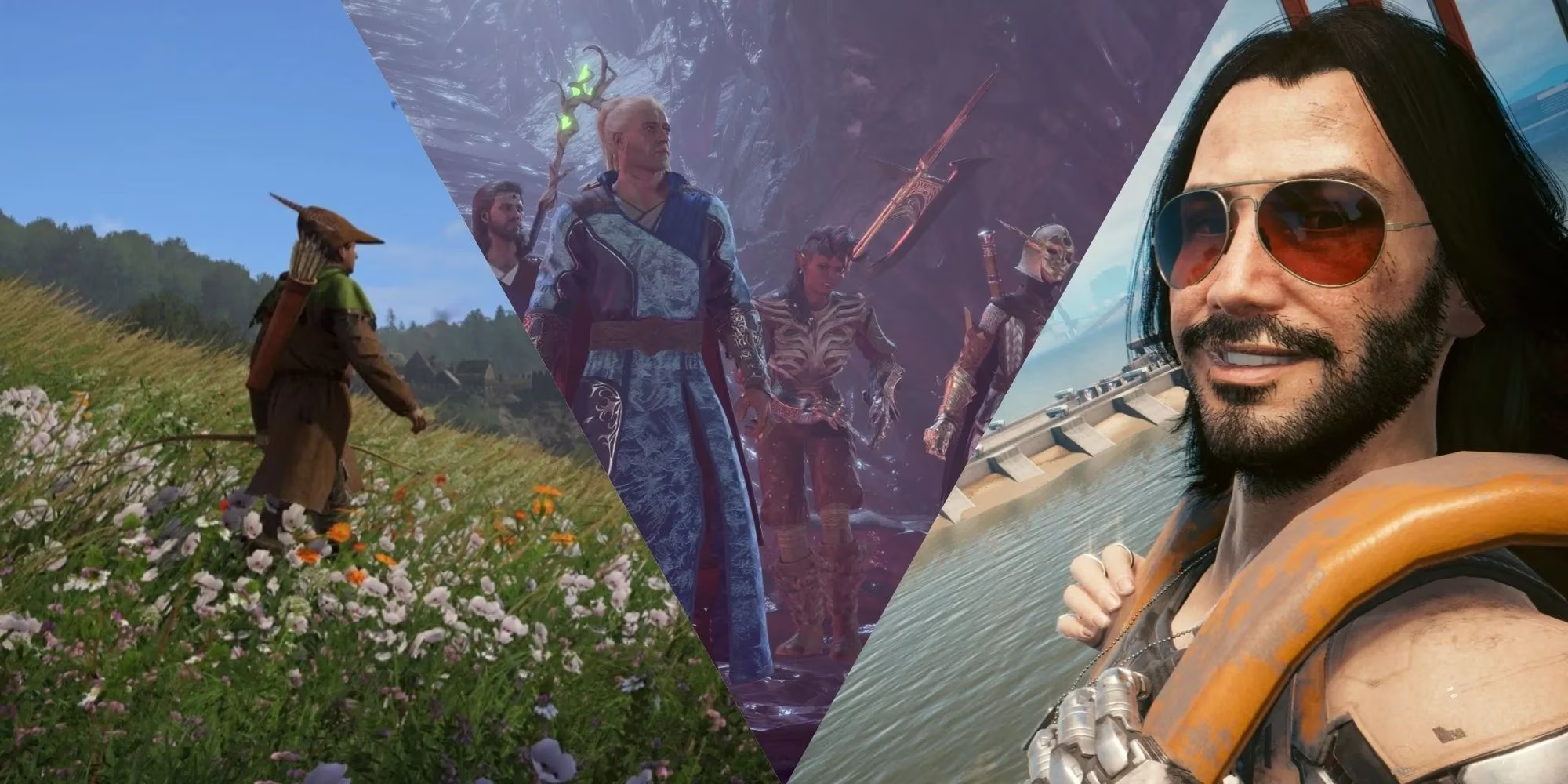
Baldur's Gate 3 proved that you don't need a massive, seamless world to create profound exploration. Its maps are more modular, but they are denser than any neutron star. Every corner of the Sword Coast is packed with interactivity, hidden passages, environmental puzzles, and narrative consequences. Exploration is a dialogue with the world. Poking around a barn might start a fight, save a prisoner, or uncover a sinister cult. The game’s systems are so deep that my path through the world was uniquely my own, shaped by countless small choices made while simply satisfying my curiosity.
The Specialists: Unique Approaches to Wandering
Some RPGs carve their niche by attaching exploration to a unique central mechanic or a specific, immersive tone.
Kingdom Come: Deliverance offered a different kind of treasure hunt: historical authenticity. Exploring the forests of Bohemia felt like stepping into a living history book. I didn't find glowing swords, but I did find authentically recreated hunting lodges, historically plausible bandit camps, and treasures that felt like real lost valuables. The exploration reinforced the game's grounded tone, making the world feel tangible and real. Random encounters, like stumbling upon two peasants having a drunken brawl, added layers of organic storytelling.
Pathfinder: Kingmaker tied exploration directly to tension through its brilliant Time Management system. The map wasn't just a space to cover; it was a resource to manage. Knowing that certain kingdom events had deadlines made every foray into the wilderness a strategic decision. Should I spend two weeks clearing this hex to secure my borders, or rush back to the capital to handle a crisis? This layer of management made exploration feel consequential and deeply woven into the core gameplay loop.
The Genre-Bending Explorers
Even RPGs famed for other elements often have exploration as a secret, stellar strength.
Final Fantasy XII was a revelation in its day. Moving away from the series' more linear roots, it offered vast, interconnected zones like the sprawling Golmore Jungle or the glittering sands of the Ogir-Yensa Sandsea. These areas were filled with rare monsters, hidden Espers, and secret chests, encouraging thorough, combat-heavy exploration. The world of Ivalice felt genuinely expansive, a precursor to the open-world designs that would become commonplace.
Cyberpunk 2077's Night City is a masterclass in vertical exploration. It’s not about how far you go, but how deep you dig. The city is a layered, dense jungle of chrome and neon. Exploration meant delving into mega-buildings, discovering hidden ripperdocs in back alleys, or finding a serene rooftop garden amidst the chaos. The sense of place is overwhelming, and the best stories are often those you find by getting gloriously lost in its districts, from the opulence of Westbrook to the desperation of Pacifica.
Xenoblade Chronicles 2 presents exploration as a breathtaking, yet dangerous, pilgrimage across the backs of living Titans. The worlds are staggeringly beautiful and diverse, from the crystalline plains of Uraya to the fiery factories of Mor Ardain. The key mechanic here is that areas do not level with you. This created unforgettable moments of tension, where a wrong turn could lead me into a zone populated by monsters dozens of levels higher, their names glowing a menacing red. The reward for braving these areas was not just loot, but some of the most stunning vistas in gaming.
The Lesson Learned: What Makes Exploration Truly Great
Reflecting on these journeys, the common thread isn't merely size. It's purpose.
-
Rewarding Curiosity: The best worlds react to your poking and prodding. A hidden cave should contain more than generic loot; it should have a journal entry, a unique enemy, or a environmental puzzle.
-
Creating Tension: Whether it's the time pressure in Kingmaker, the level disparity in Xenoblade, or the ever-present danger in Elden Ring, exploration needs stakes to feel meaningful.
-
Telling Stories: The environment itself must be a narrator. The abandoned campsite in Kingdom Come, the decaying corporate plaza in Cyberpunk, the haunted battlefields in The Witcher 3—they all tell silent stories that enrich the lore.
-
Respecting Player Agency: True exploration cannot be forced. It must be an invitation, a world that suggests possibilities and then gets out of the way, allowing me to write my own itinerary.
In 2026, as technology allows for even larger and more detailed worlds, the legacy of these games reminds us that scale is nothing without soul. The greatest RPG explorations are those that make us feel not like a tourist, but like an archaeologist, a pioneer, and a storyteller, all at once. The map is not just a tool; it is a promise of adventure, and the best RPGs are those that never break that promise.